
TL;DR:
- Dental infections often present with constant, throbbing pain, swelling, and systemic signs like fever.
- Urgent dental care is critical for symptoms like facial swelling, high fever, difficulty swallowing, or breathing.
- Early recognition and treatment prevent serious complications such as cellulitis, sepsis, or airway compromise.
Tooth pain is one of those things that’s easy to brush off until it becomes impossible to ignore. The trouble is, not every ache means the same thing. A twinge when you sip cold water is very different from a throbbing jaw that wakes you at 3am, but in the moment it can be genuinely hard to know which is which. Dental infections don’t always announce themselves loudly at first. They can start small, then escalate quickly into something that threatens more than just your tooth. This guide is designed to help residents across western Sydney and the North Ryde area identify the warning signs of a dental infection early, understand what those signs mean, and know exactly when to act.
Table of Contents
- Common symptoms that suggest a dental infection
- Serious warning signs: when to seek urgent care
- How to spot a dental infection at home
- Understanding the difference: dental infection vs. ordinary toothache
- What to expect during dental diagnosis and why urgent action matters
- A local dentist’s take: what most guides get wrong about dental infections
- Book a dental check or get urgent care with Paynless Dental
- Frequently asked questions
Key Takeaways
| Point | Details |
|---|---|
| Spot key warning signs | Look for fever, gum swelling, pain that worsens when chewing, and unusual bumps to identify likely dental infection. |
| Respond quickly to red flags | Serious symptoms like facial swelling, high fever, or difficulty swallowing mean you should seek urgent dental care. |
| Don’t rely on home remedies | Symptom relief does not mean an infection has gone; only prompt dental treatment will solve the problem. |
| Know when it’s urgent | If pain, swelling, or other changes affect your daily life or get worse, book a dentist within 24 hours. |
Common symptoms that suggest a dental infection
Let’s start by clarifying which symptoms usually mean your pain is more than “just a toothache.” Ordinary dental discomfort tends to be mild, short-lived, and linked to a specific trigger like biting down or drinking something hot. A dental infection behaves very differently.
Dental abscess symptoms typically include a cluster of signs rather than a single isolated feeling. The NHS notes that dental abscess symptoms that commonly indicate infection include high temperature (fever), swollen face or jaw, difficulty opening your mouth or chewing, a bad taste in your mouth, sensitivity to hot or cold, redness and swelling around the gum, and intense toothache or gum pain. Critically, a dental abscess does not go away on its own and requires urgent dental treatment.
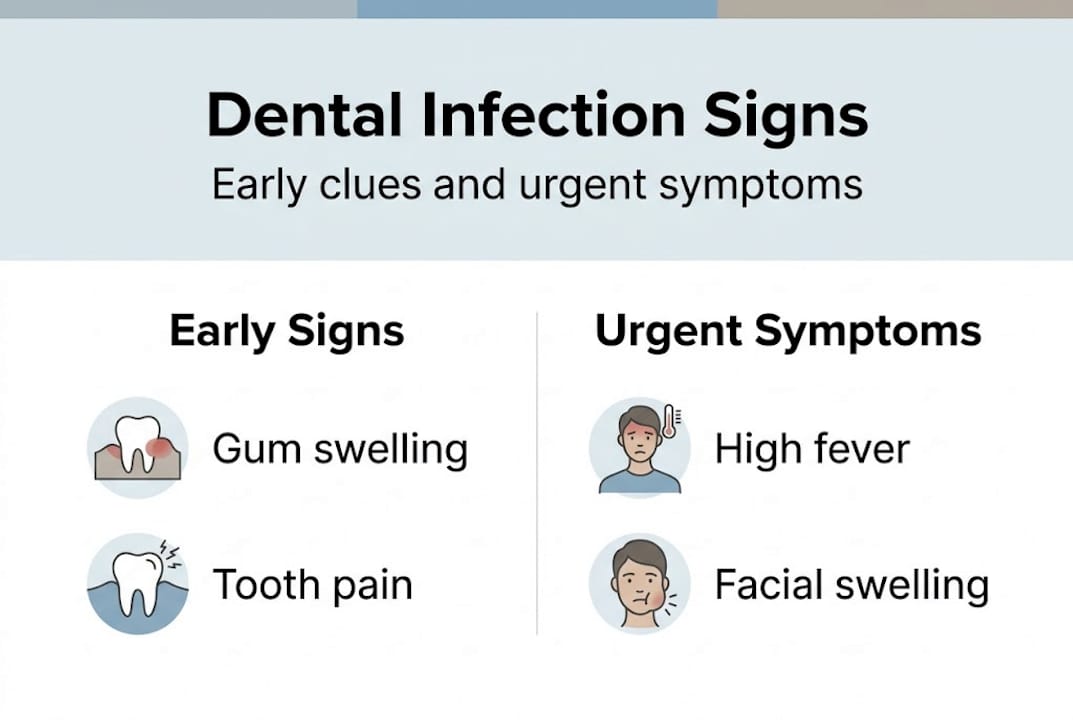
Here is a quick reference to help you sort common dental discomfort from likely infection:
| Symptom | Common toothache | Likely dental infection |
|---|---|---|
| Pain type | Dull, intermittent | Throbbing, constant |
| Fever | No | Often present |
| Swelling | Rare | Common (face, jaw, gum) |
| Bad taste or odour | Unlikely | Frequent |
| Sensitivity | Mild, brief | Intense, prolonged |
| Lymph node swelling | No | Possible |
Symptoms that suggest you need to act now include:
- Persistent throbbing pain that does not ease with over-the-counter painkillers
- Swelling of the face or jaw that appears suddenly or worsens
- A foul, bitter taste that does not clear with brushing or rinsing
- Fever alongside dental pain
- Difficulty chewing or fully opening your mouth
- Redness and tenderness around a specific tooth or section of gum
Understanding the cavity versus abscess distinction is also important. A cavity causes localised sensitivity; an abscess is a pocket of bacterial infection that has spread beyond the tooth itself.
A dental abscess will never resolve without professional intervention. Home remedies may temporarily reduce discomfort, but they do not eliminate the underlying infection. Every hour you delay increases the risk of spread.
Serious warning signs: when to seek urgent care
Recognising common symptoms is a start, but some changes warrant more urgent attention. There is a point at which a dental infection stops being just a dental problem and starts threatening your overall health. Knowing where that line is could genuinely be life-saving.
According to StatPearls clinical data, red-flag features of serious dental infection include fever above 38.5°C, signs of deep-space involvement such as trismus (difficulty opening the mouth), dysphagia (difficulty swallowing), rapidly spreading cellulitis (skin infection), or any sign of airway compromise. When these features appear, urgent evaluation and possible hospital transfer are required.
Here’s how to compare standard dental care urgency with genuine emergency territory:
| Symptom level | Timeframe to act | Action required |
|---|---|---|
| Severe pain not managed by painkillers | Within 24 hours | Emergency dentist advice |
| Facial swelling spreading rapidly | Same day | Urgent dental or hospital care |
| Fever above 38.5°C with dental pain | Immediately | Emergency services or hospital |
| Difficulty swallowing or breathing | Call 000 now | Life-threatening emergency |
| Trismus (locked jaw) | Same day | Emergency dental or ED |
If you experience any of the following, treat it as a medical emergency, not just a dental appointment to schedule:
- Your face or jaw is visibly swelling and the swelling is spreading rapidly toward your neck or eye socket
- You have a temperature above 38.5°C that is not controlled by paracetamol
- You are struggling to swallow saliva or food
- Your breathing feels restricted or difficult
- You feel confused, faint, or extremely unwell alongside the dental pain
The tooth infection severity is not always obvious from the outside. A relatively small abscess can track along tissue planes and reach dangerous areas surprisingly fast. Studies show that odontogenic infections (those originating from the teeth) account for a significant proportion of serious head and neck infections presenting to hospital emergency departments each year. Waiting to see if it “settles down” is not a safe option once red-flag symptoms appear.
Stat callout: Dental infections that spread to the neck and airway (Ludwig’s angina) are rare but rapidly life-threatening, often progressing from initial tooth pain to airway compromise within 24 to 48 hours.
How to spot a dental infection at home
Not sure if your pain means an infection? Here’s how you can check for warning signs yourself. You don’t need clinical training to notice the most common physical signs of an abscess.
A tooth abscess often presents as a red, swollen bump or pimple on the gum near the affected tooth. It may look like a small boil. Other symptoms to look for include gnawing or throbbing pain, sharp or shooting pain when you bite down, extreme sensitivity to both hot and cold that lingers for more than a few seconds, a bitter or metallic taste, bad breath that doesn’t improve with brushing, redness and noticeable swelling along the gumline, a tooth that feels loose or slightly elevated, swelling in the jaw or cheek, and possibly fever or swollen glands in the neck.
Here’s what to check systematically:
- Mirror and torch check: Look at the gum near the painful tooth. Any raised bump, redness, or swelling is significant.
- Bite pressure test: Gently tap the tooth with a fingernail. Increased pain on contact is a sign of infection at the root tip.
- Temperature sensitivity: Drink a small amount of cold water. Brief sensitivity is common. Pain that lingers for 30 seconds or more after the water is swallowed suggests deeper involvement.
- Breath and taste check: A persistent bitter or foul taste often means pus is present or draining.
- Gland check: Gently press the area just under your jaw and along the sides of your neck. Tenderness or swollen lumps in those areas suggest the infection has begun to spread.
Pro Tip: If a bump on your gum suddenly drains and your pain eases, don’t assume the problem has resolved. Spontaneous drainage often gives temporary relief, but the infection source remains. You still need professional treatment immediately.
Alongside home checks, good at-home dental care tips can help minimise discomfort while you arrange an appointment, but they should never replace it. Rinsing with warm salt water can reduce inflammation temporarily. It is not a cure.
Understanding the difference: dental infection vs. ordinary toothache
Sometimes it’s hard to tell if you’re facing a simple toothache or something more serious. The two can feel similar in the early stages, and that overlap is where many people lose valuable time.
The Merck Manual describes typical dental abscess symptoms as constant tooth pain that worsens with chewing, sensitivity to hot or cold, swelling of the gums, and sometimes fever, swelling of the jaw or floor of the mouth or cheeks, and difficulty opening your mouth or swallowing. Notice the key word: constant. Infection pain doesn’t come and go. It builds.
Ordinary toothaches typically have these characteristics:
- Triggered pain: It hurts when you bite, eat something sweet, or drink something very cold, then settles.
- Short duration: Discomfort fades quickly once the trigger is removed.
- No swelling: The gum and face look normal.
- No systemic signs: No fever, no swollen glands, no bad taste.
- Mild to moderate intensity: Manageable with a standard painkiller.
An infected tooth behaves like this:
- Unprompted pain: Aches without any trigger, often at night when lying flat.
- Persistent intensity: Pain does not ease and may actually worsen with painkillers.
- Visible changes: Swelling, redness, or a visible bump near the tooth.
- Whole-body involvement: Fever, fatigue, swollen lymph nodes.
Understanding the difference between a typical toothache versus infection is the clearest signal for whether you can schedule a routine appointment or need to pick up the phone today.
Pro Tip: If you’ve taken the maximum recommended dose of ibuprofen and paracetamol together and you’re still in significant pain, that’s a strong signal your body is dealing with more than a surface-level toothache. Don’t wait until morning to act. Look for when is an infection present by reading further guidance and then call your dentist.
What to expect during dental diagnosis and why urgent action matters
Once you spot warning signs, here’s how professionals confirm the diagnosis and why you shouldn’t wait. Knowing what happens in the dental chair can help ease anxiety around seeking care quickly.
When you present with suspected infection, the dentist will start with a thorough clinical exam. They’ll press around the affected tooth and the surrounding gum, check for swelling, and ask about your symptoms in detail. In most cases, dental X-rays are taken to assess the extent of infection around the root tip and the supporting bone. An intra-oral X-ray can reveal a periapical abscess (infection at the root tip) that is completely invisible to the naked eye.
The clinical team will then determine the treatment path. Options commonly include draining the abscess, prescribing antibiotics to control spread, performing root canal treatment to remove infected tissue from inside the tooth, or extracting the tooth if it is beyond saving. Each of these is guided by the severity of infection and how far it has progressed.
What happens when you don’t seek care promptly is well documented. The complications of untreated infection range from cellulitis spreading to the face and neck, to sepsis (a life-threatening blood infection), to deep-space infections requiring hospitalisation and sometimes surgery.
Key reasons not to delay include:
- Infections spread along tissue planes and can reach the neck, eyes, and brain faster than most people expect
- Antibiotics alone do not cure an abscess. The source of infection must be physically removed or drained
- Pain relief is not the same as treatment. A tooth that stops hurting may have died, which means the infection can continue silently
NHS guidance states that urgent dental care should be sought within 24 hours for severe tooth or mouth pain affecting sleep or daily activities, or for swelling that is growing or not resolving. Seeking care promptly is always safer than watching and waiting.
A local dentist’s take: what most guides get wrong about dental infections
Most online guides do a reasonable job of listing symptoms. What they rarely address is how those symptoms blur together in real life. At Paynless Dental, we regularly see patients who waited days or even a week before coming in because the swelling looked “manageable” or because a home remedy appeared to help initially.
The most persistent myth we encounter is that if the pain reduces, the infection is clearing. It isn’t. Spontaneous drainage or nerve death can mute the pain signal, but the bacterial load in the tissue remains. That’s a dangerous window where people feel reassured when they shouldn’t.
Another common gap is the tendency to search symptoms online, decide the situation sounds moderate, and book a standard appointment a week away. But real-world tooth pain doesn’t always match textbook descriptions neatly, and what looks like a moderate abscess on a symptom checklist can be tracking toward deep-space infection in reality.
Western Sydney and North Ryde residents have access to quality emergency dental care without long waits. The infrastructure exists. The barrier is usually the belief that the situation isn’t quite serious enough yet. In our experience, if you’re genuinely unsure whether your pain warrants urgent attention, it almost always does. Call first. Let the clinical team assess. That single step has prevented some very serious outcomes for patients who came in thinking they were overreacting.
Book a dental check or get urgent care with Paynless Dental
If you’ve recognised any of the symptoms described in this guide, the next step is straightforward. Contact a local emergency dentist at Paynless Dental as soon as possible. We see patients across western Sydney from our Toongabbie clinic, serving Wentworthville, Pendle Hill, Seven Hills, and Westmead, and at our North Ryde clinic, serving Macquarie Park, Ryde, Chatswood, and Eastwood. If an infection has progressed and the tooth cannot be saved, we also offer root canal treatment to preserve your natural tooth wherever possible, or dental implants to restore your smile if extraction becomes necessary. Don’t wait for the pain to become unbearable. Early treatment is faster, simpler, and far safer.
Frequently asked questions
How do I know if my tooth infection is serious?
If you have high fever, facial swelling, trouble swallowing, or trouble breathing, your infection is serious and you should seek emergency care immediately. These are red-flag features that signal the infection may be spreading beyond the tooth.
Can a dental infection go away without antibiotics?
A dental infection will not resolve on its own and always requires professional treatment, even if the pain temporarily improves. Antibiotics may reduce spread but cannot substitute for removing the infection source.
What should I do if I notice a bump on my gum?
A swollen bump or pimple on the gum is a key sign of an abscess and you should book an urgent dentist visit as soon as possible. Do not wait to see if it shrinks on its own.
Is intense toothache always a sign of infection?
Not always. Some toothaches come from cavities or gum irritation, but intense pain with swelling, fever, or visible gum changes makes a dental infection much more likely. When in doubt, have a dentist assess it promptly.
How soon should I see a dentist if I have swelling and pain?
You should seek urgent dental care within 24 hours if swelling appears or pain becomes severe, especially if either is worsening. Swelling that is spreading rapidly or accompanied by fever requires immediate attention today, not tomorrow.