
TL;DR:
- Dental implants are titanium posts placed into the jawbone that bond through osseointegration to support artificial teeth. They preserve jawbone better than dentures or bridges, which can lead to bone resorption over time. The treatment timeline varies from 3 to 9 months, requiring patient effort during healing and maintenance to ensure long-term success.
Dental implants are titanium posts surgically placed into the jawbone that act as artificial tooth roots, supporting natural-looking crowns, bridges, or full-arch prostheses to restore both function and appearance. The industry term is “endosseous implant,” though most Australians and their dentists simply call them dental implants or life dental implants when referring to their long-term, permanent nature. Each implant system has three core components: the titanium post, an abutment connector, and the final crown or bridge. Understanding how implants work from the biology upward is the clearest way to set realistic expectations before committing to treatment.
How do life dental implants work?
Dental implants bond through osseointegration, a biological process where living bone cells grow directly onto the titanium surface and lock the post in place. This is what separates implants from every other tooth replacement option. No adhesive, no clasps, no reliance on neighbouring teeth. The implant becomes structurally part of your jaw.
The dental implant procedure follows a clear sequence, though the exact timeline varies by patient:
- Consultation and imaging. CBCT scanning and bone quality evaluation determine whether direct placement is possible or whether bone grafting is required first. This step drives every downstream decision.
- Bone grafting (if needed). Patients with insufficient bone volume require grafting before implant placement. Even a modest graft adds weeks to the overall timeline and affects healing.
- Implant placement. The titanium post is placed into the prepared socket under local anaesthetic, often with sedation available for anxious patients.
- Osseointegration. Healing takes 3 to 6 months in the lower jaw and up to 7 months in the upper jaw. The upper jaw has lower bone density, which slows the bonding process.
- Abutment placement. Once the implant is stable, the abutment is attached to connect the post to the final restoration.
- Crown or bridge fitting. The prosthetic tooth is secured, adjusted for bite, and polished. Total treatment time runs from 3 to 9 months depending on complexity.
Pro Tip: Ask your clinician for your specific osseointegration milestone criteria before treatment begins. Knowing what stability measurements trigger crown loading gives you a concrete benchmark rather than an open-ended waiting period.
Upper jaw cases genuinely do take longer, and patients who expect a 3-month turnaround for a maxillary implant are often disappointed. Setting the right timeline from the start prevents frustration mid-treatment.

Dental implants vs dentures and bridges: which is better?
The honest comparison between implants, dentures, and bridges comes down to three factors: bone preservation, long-term cost, and daily function. Implants win on the first two; bridges and dentures win on upfront affordability.
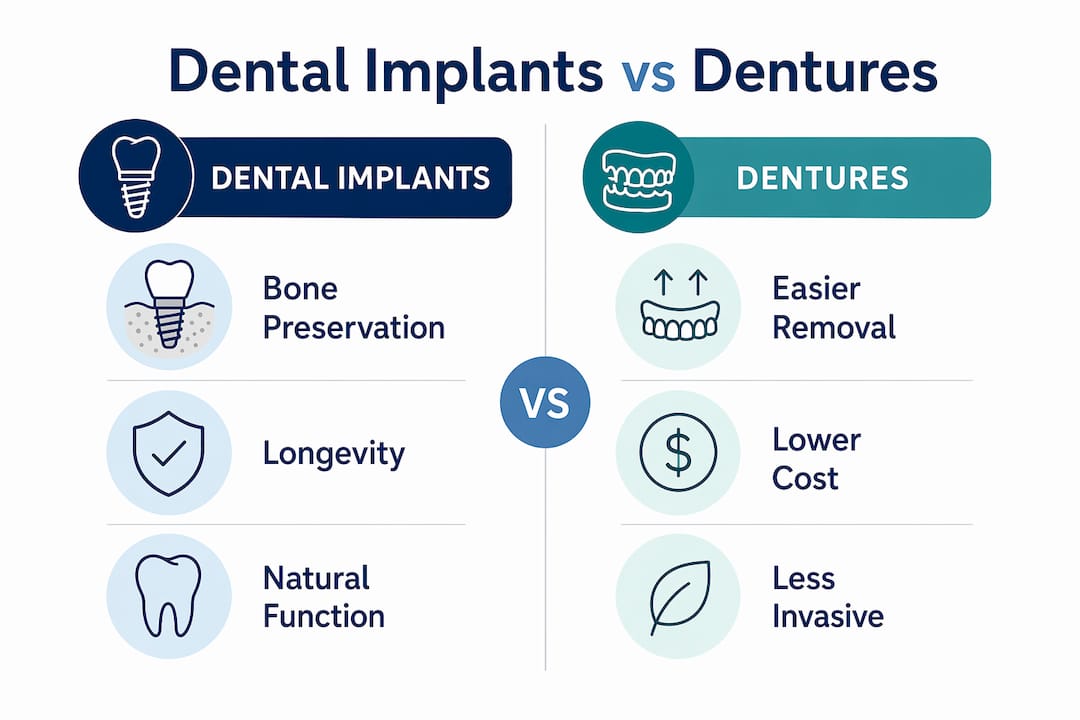
Implants preserve jawbone better than dentures or bridges because the titanium post stimulates bone the same way a natural root does. Dentures sit on the gum surface and provide no root stimulus, so the underlying bone gradually resorbs over years. Bridges rely on crowning adjacent healthy teeth, which sacrifices tooth structure that cannot be recovered.
| Feature | Dental implants | Dentures | Bridges |
|---|---|---|---|
| Jawbone preservation | Yes, stimulates bone | No, bone resorbs over time | Partial, no root stimulus |
| Adjacent teeth affected | No | No | Yes, requires crowning |
| Lifespan | 15 to 25+ years with care | 5 to 10 years before reline or replacement | 10 to 15 years typically |
| Maintenance | Daily brushing, flossing, check-ups | Daily removal, soaking, adhesive | Standard brushing, flossing |
| Upfront cost (AUD) | $2,850 to $6,500+ per tooth | $1,500 to $3,500 for full arch | $2,500 to $5,000 per unit |
| Comfort and stability | Fixed, feels natural | Can shift or slip | Fixed but relies on adjacent teeth |
For a deeper comparison, the implants vs bridges breakdown at Paynless Dental covers clinical trade-offs in practical detail.
Key points worth knowing before you decide:
- Implants carry a higher upfront cost but avoid the recurring replacement costs that dentures accumulate over a decade.
- Patients with multiple missing teeth often find that implant-supported dentures offer a middle ground between full implant reconstruction and conventional removable dentures.
- Bridges are a reasonable short-term solution when bone volume is insufficient for implants and grafting is not viable.
What to expect during recovery after implant placement
Soft tissue heals within roughly 2 weeks of implant placement, and most patients feel functionally normal well before their crown is fitted. The more significant process, osseointegration, continues silently for 3 to 6 months. Feeling comfortable does not mean the implant is ready to be loaded.
During the integration phase, patients must protect the implant biomechanically by avoiding hard, crunchy, or chewy foods on the implant side. Early overloading, placing bite force on an implant before bone fusion is complete, is one of the most preventable causes of implant failure.
Recovery guidelines that make a measurable difference:
- Eat soft foods such as yoghurt, scrambled eggs, mashed vegetables, and fish for the first 6 to 8 weeks post-placement.
- Avoid smoking entirely during healing. Smoking reduces blood flow to the gum tissue and significantly impairs osseointegration.
- Maintain meticulous oral hygiene around the implant site using a soft-bristle brush and non-abrasive toothpaste.
- Attend every scheduled review appointment. Clinicians assess stability and catch early signs of peri-implant mucositis, which affects roughly 33.6% of implant cases but is manageable when caught early.
- Report any persistent swelling, pain, or mobility of the implant immediately. These are not normal beyond the first week.
Pro Tip: Schedule your return to normal dietary function around your clinician’s stability assessment, not the calendar. Bone healing is biological, not time-based, and rushing this phase is the most common patient-driven complication.
Peri-implant mucositis, inflammation of the soft tissue around the implant, is the most common complication. It responds well to professional cleaning and improved home hygiene. Peri-implantitis, the more serious bone-level infection, is rare at 0.4% of cases but requires prompt intervention. Consistent periodontal maintenance after implants is the single most effective prevention strategy.
How much do dental implants cost in Australia in 2026?
Single dental implants in Australia cost between AUD $2,850 and $6,500 for straightforward cases. That range reflects significant variation in imaging, sedation, and the complexity of the surgical site. Cases requiring bone grafts or sinus lifts push costs to between AUD $4,000 and $11,500 per implant. These are not outlier scenarios. A large proportion of patients presenting with long-standing tooth loss require some form of bone augmentation.
| Treatment type | Estimated cost (AUD 2026) |
|---|---|
| Single implant, straightforward | $2,850 to $6,500 |
| Single implant with bone graft or sinus lift | $4,000 to $11,500 |
| All-on-4 full arch solution | $15,000 to $30,000 |
| Implant-supported denture (per arch) | $8,000 to $20,000 |
Full-arch solutions such as All-on-4 and All-on-6 cost approximately AUD $15,000 to $30,000 per arch. These figures include the surgical placement, the prosthetic framework, and the final teeth. They do not always include pre-surgical imaging, sedation fees, or follow-up appointments, so ask for a fully itemised quote.
Factors that affect your final cost include:
- Number of implants required and whether staged or immediate loading is used.
- Whether CBCT imaging is included in the consultation fee or billed separately.
- Sedation type: local anaesthetic, oral sedation, or IV sedation carry different fees.
- Clinician experience and clinic location. Sydney metropolitan practices generally charge more than regional providers.
For a detailed breakdown of affordable implant options in Australia, Paynless Dental’s cost guide covers what drives price variation and where genuine savings are possible without compromising on implant quality.
Key takeaways
Dental implants are the only tooth replacement that preserves jawbone, functions like a natural root, and offers a lifespan measured in decades with proper maintenance.
| Point | Details |
|---|---|
| Osseointegration drives the timeline | Bone fusion takes 3 to 7 months depending on jaw location and bone quality. |
| Bone preservation is the key advantage | Implants stimulate the jawbone; dentures and bridges do not, leading to gradual bone loss. |
| Recovery requires active patient effort | Diet modification and avoiding early overload are the most controllable success factors. |
| Australian costs vary widely | Single implants range from AUD $2,850 to $11,500 depending on complexity and additional procedures. |
| Long-term maintenance is non-negotiable | Regular professional reviews and home hygiene prevent peri-implant mucositis and protect implant longevity. |
What I’ve learned from watching patients choose implants
After years of working alongside patients navigating tooth replacement decisions, the pattern I see most often is this: people underestimate how much the pre-surgical assessment matters and overestimate how passive the recovery phase is.
The CBCT scan and bone quality evaluation are not administrative steps. They determine whether your implant has a realistic chance of long-term success. Patients who skip detailed imaging to save a few hundred dollars upfront sometimes find themselves facing implant failure that costs far more to address. The assessment is where the real clinical work begins.
On longevity, I think the industry does patients a disservice by framing implants as a “lifetime” solution without qualification. Ten-year implant survival rates are strong at around 93.7% at the implant level, but that figure assumes consistent maintenance. Implants are better understood as a long-term investment that requires ongoing stewardship, not a one-time fix.
For patients who grind their teeth, the risk of technical complications from bruxism is real and underappreciated. An occlusal guard is not optional for these patients. It is part of the treatment plan. Skipping it to save money is a false economy when you consider the cost of repairing or replacing a fractured crown or abutment.
The upfront cost of implants is real, and I understand why patients hesitate. But the alternative, replacing dentures every 7 to 10 years while watching bone volume decline, carries its own compounding cost. The patients I see who are most satisfied with their decision are those who went in with clear expectations, followed their recovery guidelines, and committed to regular professional care.
— Ashish
Affordable dental implants at Paynless Dental
Paynless Dental offers dental implant solutions across two Sydney locations, the Toongabbie clinic serving Wentworthville, Pendle Hill, Seven Hills, and Westmead, and the North Ryde clinic serving Macquarie Park, Ryde, Chatswood, and Eastwood. The practice specialises in single tooth implants, multiple tooth implants, All-on-4 and All-on-6 full-arch solutions, implant-supported dentures, and bone grafting. Paynless Dental uses advanced imaging and treatment planning technology to deliver predictable outcomes at competitive pricing. Book a consultation to receive a fully itemised treatment plan with no surprises, and take the first concrete step toward restoring your smile with confidence.
FAQ
What are dental implants made of?
Dental implants are made from titanium, a biocompatible metal that bonds directly with living bone through osseointegration. The crown or bridge attached to the implant is typically made from porcelain or zirconia for a natural appearance.
How long does the dental implant procedure take?
The full dental implant procedure takes between 3 and 9 months from placement to final crown fitting, depending on whether bone grafting is needed and how quickly osseointegration progresses in the individual patient.
Are dental implants worth the cost in Australia?
For most patients, dental implants are worth the upfront investment because they preserve jawbone, function like natural teeth, and last significantly longer than dentures or bridges, reducing long-term replacement and maintenance costs.
How do I care for dental implants long-term?
Dental implant care requires daily brushing and flossing around the implant, using a soft-bristle brush, and attending professional cleaning appointments every 6 months. Patients who grind their teeth should use an occlusal guard to protect the implant and crown.
Can anyone get dental implants?
Most healthy adults with sufficient jawbone density are candidates for dental implants. Patients with bone loss may require grafting first, and those with uncontrolled diabetes or active gum disease need those conditions managed before implant placement proceeds.