
TL;DR:
- Many Western Sydney seniors assume dental implants are unaffordable, but public programs and flexible payment plans make them accessible. Eligibility depends on concession cards, residency, and clinical need, offering significant savings for qualified individuals. Exploring both public and private options early increases chances of obtaining implants at a manageable cost.
Many Western Sydney seniors quietly assume dental implants are only for those with deep pockets, but that assumption may be costing them their comfort, confidence, and long-term oral health. The truth is that a combination of public dental programmes, community-focused private clinics, and flexible payment plans has made implants more reachable than most people realise. This guide maps the real options available right now in Western Sydney, cuts through the confusion around cost and eligibility, and gives you practical steps to move forward with confidence.
Table of Contents
- Understanding dental implants and affordability
- How public dental programmes support affordable implants
- Comparing public and private implant pathways
- Practical tips for getting affordable dental implants locally
- Why most seniors overlook the best pathway for affordable implants
- Affordable dental implant solutions in Western Sydney
- Frequently asked questions
Key Takeaways
| Point | Details |
|---|---|
| Eligibility matters | Seniors with Medicare plus a concession card have priority access to public dental implant programs. |
| Public and private options | You can choose between public programs (for eligible cases) and private clinics, each with different costs and wait times. |
| Prepare documents | Having Medicare, concession cards, and health history ready streamlines your application or consultation. |
| Explore alternatives | If implants aren’t available, dentures and bridges may offer affordable solutions for restoring your smile. |
Understanding dental implants and affordability
Dental implants are small titanium posts that a dentist places directly into your jawbone, acting as an artificial tooth root. A crown, bridge, or denture then attaches to the post above the gum line. The result feels and functions like a natural tooth, allowing you to eat, speak, and smile without the slipping or discomfort that traditional dentures can bring.
For seniors, this matters enormously. Missing teeth affect far more than appearance. They change how you chew food, which can impact nutrition. They alter speech patterns. Over time, bone loss in the jaw accelerates without tooth roots to stimulate it. Implants are the only restorative solution that directly addresses bone loss, which is why so many dental professionals consider them the gold standard.
So why do so many seniors avoid even asking about them? Cost is almost always the answer. Private dental implant prices in Australia commonly range from $3,000 to $6,500 per tooth when you factor in the implant post, abutment, and crown together. Full-mouth solutions can run considerably higher. These figures are real, and they are daunting. But they are also not the only figures available.
Before writing implants off as unaffordable, it is worth knowing that dental implant treatments may be available through select public programmes for eligible Western Sydney seniors. That changes the conversation entirely.
Several factors drive the total price of private implant treatment:
- Number of implants needed: A single tooth implant costs far less than a full-arch solution like All-on-4 or All-on-6.
- Bone grafting requirements: If jawbone has deteriorated, grafting may be needed before implant placement, adding to the overall cost and timeline.
- Choice of materials: Zirconia crowns on top of implants cost more than standard porcelain options.
- Clinic location and technology: Clinics using advanced digital imaging and same-day crown technology often charge a premium.
- Anaesthetic preferences: General anaesthesia versus local anaesthetic significantly changes the price.
If you are exploring your missing teeth options for the first time, understanding these variables helps you compare quotes intelligently rather than simply choosing the lowest number.
“The real cost of doing nothing is often greater than the cost of treatment. Bone loss from missing teeth is progressive and eventually makes implant placement more complex and expensive.”
Pro Tip: When contacting any dental clinic, ask them to itemise the full treatment plan in writing before you commit. Request a breakdown that includes the implant post, abutment, crown, any bone grafting, imaging fees, and follow-up appointments. This makes comparison between public and private options genuinely meaningful.
How public dental programmes support affordable implants
With those basics clear, let us spotlight how public programmes in Western Sydney can make implants possible at little to no cost for eligible seniors.
Public dental care and selected implant treatments are available to eligible residents who hold relevant concession cards. This is not widely advertised, and many seniors simply do not know they may qualify. The Western Sydney Local Health District runs oral health services that include access pathways for complex restorative treatments in select clinical cases.
Services are free for eligible patients holding Medicare and concession cards in the Western NSW LHD. Eligible cards typically include the Pensioner Concession Card, the Health Care Card, and certain Department of Veterans’ Affairs cards. Residency within the relevant Local Health District catchment area is also required.
Here is a simplified eligibility comparison to help you see where you stand:
| Eligibility factor | Public dental programme | Private clinic |
|---|---|---|
| Medicare card required | Yes | No |
| Concession card required | Yes (Pensioner, HCC, DVA) | No |
| LHD residency required | Yes | No |
| Income means-tested | Sometimes | No |
| Clinical suitability assessed | Yes | Varies |
The process for accessing public implant services typically follows these steps:
- Confirm your concession card status and ensure your Medicare enrolment is current before making any enquiry.
- Contact your nearest Western Sydney LHD oral health service to ask whether you are eligible and whether implant treatments are currently within their programme scope.
- Request a formal clinical assessment. Implants through public programmes are only provided in selected clinical cases where they are deemed the most appropriate treatment.
- Join the waiting list if you are eligible and your case is accepted. Public dental services in high-demand areas often carry wait times, so it pays to start this process early.
- Attend all scheduled consultations and bring your concession card, Medicare card, and a full medical history to each appointment.
The honest reality is that public programme implants are not guaranteed. Availability depends on clinical necessity, programme capacity, and funding cycles. But for seniors who qualify, the saving can be enormous, making it the most important first call to make.
For more detail on accessing this pathway, the guide to free dental implants for seniors in Western Sydney covers eligibility in greater depth, and the overview of affordable dental care options maps out related programmes worth exploring.
Comparing public and private implant pathways
Having explored the public path, it is helpful to weigh this alongside the realities of going private in Western Sydney.
Public implant programmes have eligibility requirements, but private implant clinics offer shorter wait times for those able to self-fund. The decision between pathways is rarely black and white, and many seniors end up pursuing both options simultaneously to avoid missing out.
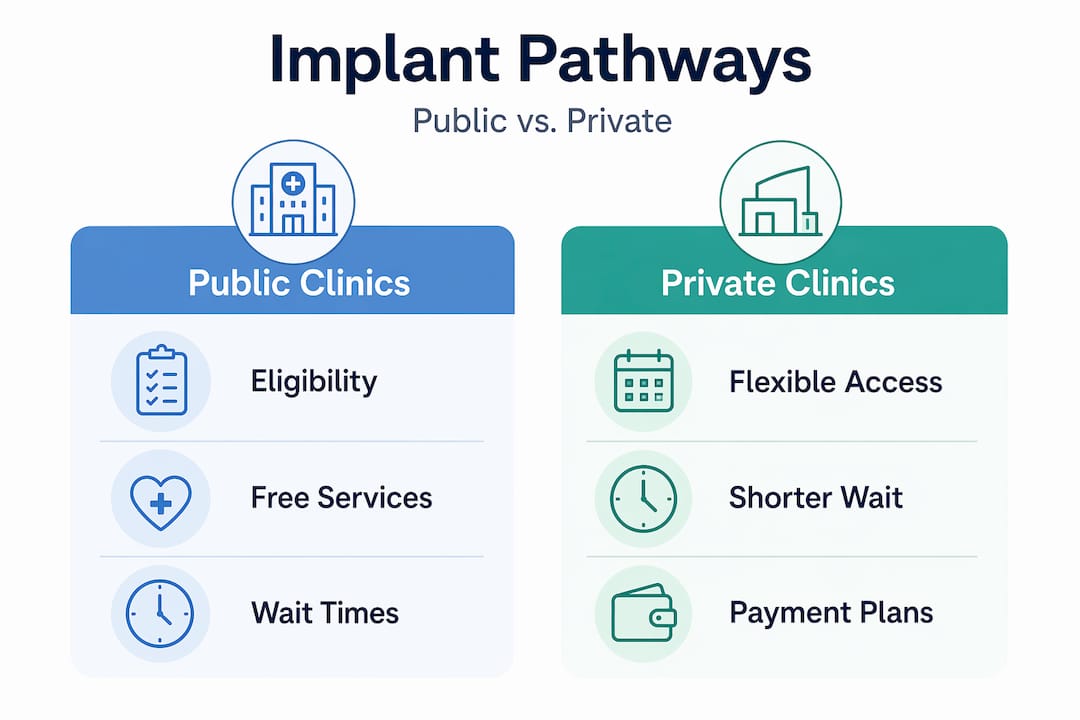
Here is a direct comparison of the two pathways:
| Factor | Public programme | Private clinic |
|---|---|---|
| Cost to patient | Free or heavily subsidised | $3,000 to $6,500+ per implant |
| Wait times | Weeks to months | Days to weeks |
| Eligibility barriers | Concession card, Medicare, LHD residency | None (financial capacity only) |
| Treatment choice | Clinically determined | Patient and clinician decide together |
| Technology and comfort | Functional, varies by facility | Often advanced, premium equipment |
| Payment plans available | Not applicable | Yes, at many clinics |
| Follow-up care | Included | Itemised separately |
Benefits of the public pathway:
- Eliminates or dramatically reduces out-of-pocket costs
- Clinically supervised at every stage
- Suitable for seniors on fixed incomes
Benefits of the private pathway:
- Faster access to treatment
- Greater choice of implant materials and techniques
- More flexibility in scheduling and location
- Access to advanced options like All-on-4, All-on-6, or implant-supported dentures
What seniors often sacrifice with each pathway:
- Public: Potentially longer wait, less clinical choice, dependent on programme capacity
- Private: Upfront cost or payment plan commitment, though flexible options exist
For a thorough breakdown, the cheap dental implants comparison resource covers additional variables worth reviewing. If private is the path forward, understanding dental payment plans in Western Sydney will help you manage cost without delay.
Pro Tip: If you are on a concession card and facing a moderate wait time through the public programme, consider booking a private consultation in parallel. Some seniors find that exploring both paths simultaneously gives them the most information and the fastest possible treatment timeline regardless of which option they ultimately choose.
Practical tips for getting affordable dental implants locally
Ready to take action? Here are the key steps and tips to make the path as affordable and smooth as possible.
Seniors can enhance eligibility and preparedness by confirming their concession card status before seeking a referral or consultation. This single step prevents unnecessary delays and ensures you are presenting the right information from the start.
Step-by-step actions to take right now:
- Check your concession card validity. Visit a Services Australia office or check online to confirm your Pensioner Concession Card, Health Care Card, or DVA card is current and correctly linked to your Medicare number.
- Gather your documents. You will need your Medicare card, concession card, a list of current medications, details of any medical conditions such as diabetes or osteoporosis, and records of previous dental treatment if available.
- Call the Western Sydney LHD oral health service. Ask specifically whether dental implant treatments are currently available under the programme and what the current wait time is for an initial assessment.
- Book a private consultation simultaneously. Even if cost seems prohibitive, many clinics offer no-obligation consultations where they can outline all costs clearly and discuss payment options.
- Ask the right questions at every consultation. Do not leave without understanding the full treatment plan, total itemised cost, expected timeline, and what happens if additional procedures like bone grafting are required.
- Explore payment plan options early. Many private clinics offer interest-free periods or staged payment arrangements that make implants manageable on a pension-level income.
Key documents to bring to any dental consultation:
- Medicare card and any concession cards held
- Current medication list and dosage information
- Medical history, especially conditions that affect healing or bone health
- Any previous dental X-rays or treatment records
- Contact details for your GP if a medical clearance may be needed
Questions to ask your dentist before proceeding:
- Is bone grafting likely to be needed, and is it included in the quoted price?
- What implant brand and materials will be used?
- How many appointments will the full process require?
- What warranty or guarantee applies to the implant and crown?
- What are the maintenance requirements and long-term costs?
These oral health tips for seniors provide additional guidance on preparing for and maintaining good outcomes through dental treatment.
Pro Tip: Ask your dentist whether a staged treatment approach is possible. Some clinics allow you to complete the bone grafting and implant placement in one financial year, and the crown placement in the next, which can spread out-of-pocket expenses across two budget periods significantly.
Why most seniors overlook the best pathway for affordable implants
Let us step back and share why so many still miss out, and what experience really teaches about finding affordable solutions.
The most common reason seniors never access public programme implants is straightforward: they assume the answer is no before they ever ask the question. Years of being told implants are expensive creates a mental barrier that feels like a fact, even when it is not. The assumption calcifies into a belief, and the belief stops people from making a single phone call that could change their situation entirely.
There is also a generational dynamic at play. Many older Australians are uncomfortable asking for assistance or pressing for services they feel they might not deserve. But accessing a funded health programme that you are entitled to is not charity. It is using a system that was designed specifically for your circumstances.
Choosing public dental programmes first is the most practical path for eligible seniors, especially when private prices are much higher. Our experience tells us that the seniors who end up with the best outcomes are the ones who make that first call early, even when they feel uncertain about eligibility.
Private clinics absolutely have a role to play. For seniors who do not qualify for public funding, or who cannot wait for a public placement, a well-structured private plan with payment flexibility can be excellent value. But the sequence matters. Check public eligibility first. Then, armed with that information, evaluate private options with full knowledge of what you may or may not qualify for.
The free dental implants explanation resource breaks this process down in plain language if you want to explore the public side further before making any calls.
Do not let outdated assumptions about cost make that decision for you. The landscape has genuinely changed, and Western Sydney seniors have more options today than at any point before.
Affordable dental implant solutions in Western Sydney
For those who want direct guidance or a fast-track to all implant and restorative options available locally, here is how Paynless Dental can help.
At Paynless Dental, we work with seniors across Western Sydney from our Toongabbie and North Ryde clinics to find pathways to treatment that genuinely fit your budget and health needs. Whether you are exploring affordable dental implants for the first time or investigating whether an implant-supported denture might suit you better than a single tooth replacement, we take the time to map out every option clearly. If implants are not the right fit for your situation right now, we will also walk you through solutions like dental bridges and our range of affordable dentures so that you leave every consultation knowing your choices. Book a no-obligation consultation with our team today and take the first step toward lasting oral health.
Frequently asked questions
Who qualifies for free or low-cost dental implants in Western Sydney?
Seniors with Medicare and an eligible concession card may access selected implant treatments through public dental programmes in Western Sydney, depending on clinical need. Eligibility requires LHD residency plus one of the listed concession cards and a current Medicare enrolment.
Are dental implants always available for free under public programmes?
No, implants are only available in selected clinical cases and are subject to programme capacity and eligibility requirements. Dental implants may be available in selected cases under the programme’s included services, not as a universal entitlement.
What should I do if denied a public programme dental implant?
Explore affordable private options or alternative restorative solutions such as dentures or bridges at community-focused dental clinics like Paynless Dental, where flexible payment plans are available.
What documents will I need for a dental implant consultation?
Bring your Medicare card, concession card if applicable, a current list of medications, and your medical history, including any conditions that affect bone health or healing.
Are there payment plan options for private dental implants?
Yes, many local clinics including Paynless Dental offer flexible payment plans to help seniors manage implant treatment costs without needing to pay the full amount upfront.