
TL;DR:
- Stress in Western Sydney is ongoing and often invisible, but brief, targeted mindfulness exercises can effectively reduce it. Simple practices like a 3-minute body scan or guided audio sessions tailored to local cultural context are practical, evidence-based tools for managing daily pressure. Personalizing and consistently practicing these techniques helps build resilience and supports overall wellbeing in this busy community.
Stress in Western Sydney is real, constant, and often invisible to the people around you. Whether you’re navigating peak-hour traffic on the M7, managing work deadlines, or juggling family commitments across Wentworthville, Pendle Hill, or Ryde, the pressure builds fast. Most mindfulness guides you’ll find online are either too abstract to action or demand 30-plus minutes a day you simply don’t have. This article cuts through that noise and gives you practical, evidence-backed mindfulness exercises that are brief, accessible, and genuinely suited to the rhythms of life in Western Sydney.
Table of Contents
- What makes a mindfulness exercise simple and effective?
- The 3-minute mindful body scan
- 5-minute mindful breathing: Local audio options
- Comparing mindfulness exercises: Which is best for you?
- Tips for personalising your mindfulness routine
- Our perspective: What actually works for local stress relief
- Support your wellbeing and oral health with Paynless Dental
- Frequently asked questions
Key Takeaways
| Point | Details |
|---|---|
| Ultra-short exercises work | Mindful body scan and breathing can relieve stress in as little as three minutes. |
| Local audio guides available | Western Sydney residents can access free mindfulness recordings from their university. |
| Choose according to stress type | Body scan and breathing options suit different needs—acceptance helps with acute stress, monitoring with ongoing stress. |
| Personalise your approach | Adjust practices if they feel distressing and select what fits your routine and comfort. |
| Consistency beats perfection | Brief, regular mindfulness is more effective than rare, intensive sessions. |
What makes a mindfulness exercise simple and effective?
Not every mindfulness exercise is worth your time. The good news is that controlled evidence shows mindfulness-based interventions produce measurable reductions in perceived stress in non-clinical adults, which means ordinary people like you and I. But for it to work, the exercise needs to meet a few key criteria.
Brevity matters. Simple mindfulness is usually under 10 minutes. Anything longer becomes a commitment most people abandon within a week. Short sessions fit into commutes, lunch breaks, or the five minutes before a stressful meeting.
An anchor keeps you grounded. Every effective mindfulness exercise uses an “anchor,” which is a specific point of focus that brings your attention back when it wanders. Common anchors include your breath, the sensations in your body, or even a simple sound. Without an anchor, your mind drifts and the practice loses its effect.
Acceptance is non-negotiable. Mindfulness without non-judgement is just overthinking with your eyes closed. The key is to notice thoughts, feelings, and sensations without labelling them as good or bad. This acceptance is what separates genuine mindfulness from ordinary distraction.
Local relevance makes it stick. Western Sydney residents have a distinct advantage here. Resources like those found at Western Sydney University are tailored for local students and community members, meaning the language, tone, and cultural context actually resonate. You can also explore mindfulness for dental anxiety as a starting point if stress tends to spike before appointments, or check out natural calming steps for a broader toolkit.
Here’s what to look for when choosing an exercise:
- Takes 10 minutes or less
- Uses a clear anchor (breath, body, sound)
- Encourages non-judgement, not forced relaxation
- Can be done anywhere, including your car, desk, or lounge
- Backed by evidence for mindfulness from credible sources
Pro Tip: Choose exercises you can use wherever stress shows up. If your stress peaks during the morning school run, a seated breathing exercise probably won’t help you there. A quick breath anchor you can use while walking will.
One-size-fits-all rarely works with mindfulness. What grounds one person may frustrate another. The goal is finding an anchor and format that feel natural for you, then repeating it consistently.
The 3-minute mindful body scan
The 3-minute body scan is one of the most accessible and effective tools in the mindfulness toolkit. It requires no equipment, no special environment, and no prior experience. A 3-minute body scan style practice is widely recognised as a concrete, very short option for genuine stress relief.
Here’s how to do it, step by step:
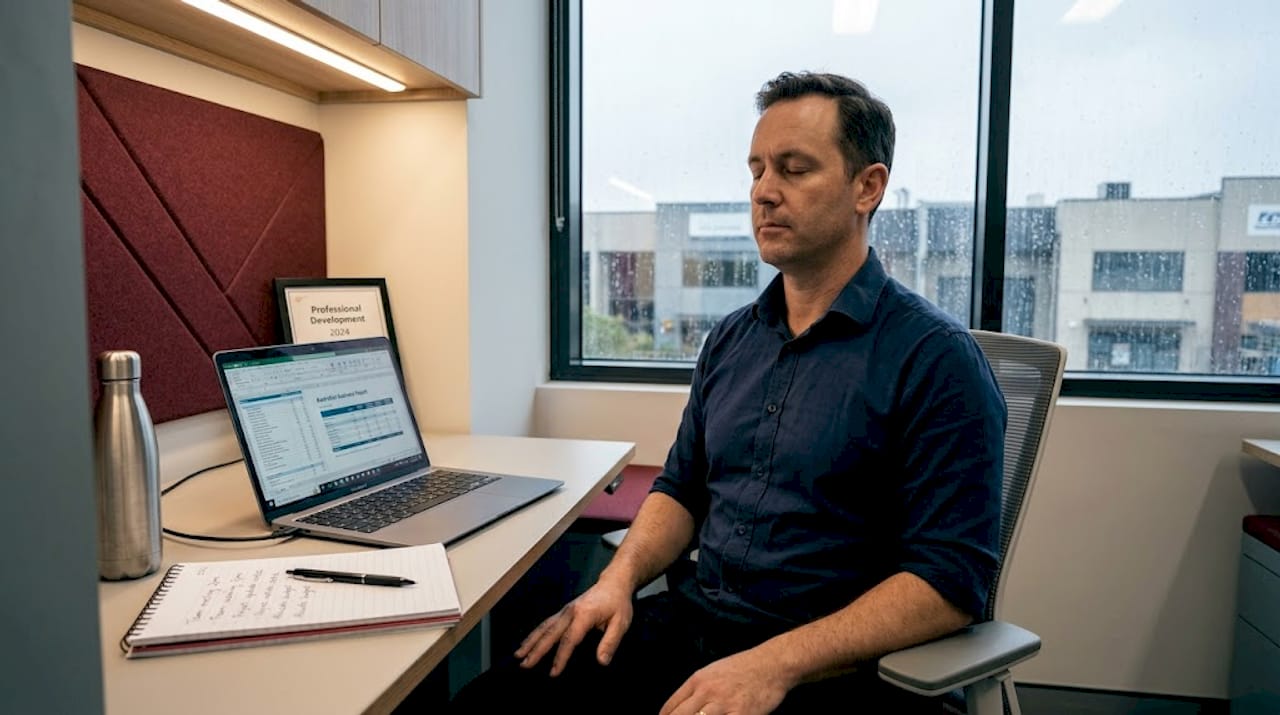
- Find a comfortable position. Sit upright in a chair with your feet flat on the floor, or lie down if you have the space. Close your eyes or soften your gaze downward.
- Take three slow breaths. Breathe in through your nose for four counts, out through your mouth for six. Let your shoulders drop with each exhale.
- Start at the top of your head. Notice any tension, tingling, or pressure. Don’t try to fix it. Simply observe it.
- Move slowly down through your body. Neck, shoulders, chest, belly, arms, hands, hips, thighs, calves, feet. Spend about 10 to 15 seconds on each area.
- Relax each area gently. If you notice tension, imagine breathing into that spot and releasing it on the exhale. Don’t force it.
- End with three full breaths. Open your eyes slowly and return to the room.
For further guidance, the body scan meditation guide from the Greater Good Science Centre at UC Berkeley offers a thorough walkthrough you can bookmark.
“The mindful body scan can deliver noticeable relief in just minutes, making it one of the most practical tools for everyday stress management.”
The numbers back this up too. Across multiple studies, mindfulness-based interventions have shown a standardised mean difference of 0.53 in stress reduction (p < .00001), which is a statistically significant and clinically meaningful result. That’s not a placebo effect. That’s real change happening in real people.
This exercise is particularly useful during acute stress spikes, such as before a difficult conversation, after receiving bad news, or midway through a challenging day. It’s also worth noting that body awareness practices like this one pair well with broader wellbeing habits. For instance, simple breath-freshening tips can support the same kind of mindful attention to your body that makes the body scan so effective.
5-minute mindful breathing: Local audio options
Beyond manual practice, Western Sydney residents have access to guided options that make mindfulness even simpler. Western Sydney University provides short, locally relevant mindfulness recordings designed specifically for stress and wellbeing support, including 5-minute breathing options that anyone in the community can use.
Guided audio takes the mental effort out of the practice. Instead of remembering the steps yourself, you simply follow a voice. This is especially helpful when your stress levels are already high and self-directed focus feels impossible.
Here’s how the main local audio session types compare:
| Session type | Length | Format | Best for |
|---|---|---|---|
| Mindful breathing | 5 minutes | Voice only | Morning routine, work breaks |
| Body relaxation | 10 minutes | Voice with music | Evening wind-down |
| Stress release | 7 minutes | Voice only | Midday reset |
| Sleep relaxation | 15 minutes | Soft music + voice | Pre-sleep anxiety |
Key benefits of using guided audio for your practice:
- No guesswork about whether you’re “doing it right”
- Consistent pacing keeps your attention from wandering
- Voice cues provide a reliable external anchor
- Available on demand, any time of day or night
- Developed by local university counselling professionals who understand Western Sydney context
If you’re open to exploring beyond local university resources, a free mindfulness app can supplement your practice with additional breathing and body scan tracks.
Booking and managing your time is part of making wellness sustainable. If you’re already thinking about how to streamline your health appointments, understanding booking resources in Western Sydney can reduce one source of stress before it starts.
Pro Tip: Try at least three different audio styles before settling on one. Some people find voice-only tracks easier to focus on, while others need gentle background music to prevent their mind from generating its own noise. Neither preference is wrong.
Comparing mindfulness exercises: Which is best for you?
To make it easier to choose, here’s a comparison of how the main exercises differ and which might suit different needs.
| Exercise | Time required | Best stress type | Key strength | Limitation |
|---|---|---|---|---|
| 3-minute body scan | 3 minutes | Acute stress spikes | Immediate physical release | Needs quiet space ideally |
| 5-minute breathing | 5 minutes | Basal ongoing stress | Easy to repeat often | Less body awareness |
| Guided audio session | 5 to 15 minutes | Both acute and chronic | Removes self-direction effort | Needs device and audio |
Research indicates that the mechanisms behind mindfulness may depend heavily on whether a practice trains “monitoring and attention” versus “acceptance,” and whether your stress is in an acute challenge state versus a longer-term basal state. This distinction matters more than most people realise.
For example, if you’re stressed because of an immediate situation (a heated meeting, a dental visit, an unexpected bill), acceptance-based practices that acknowledge the discomfort without fighting it tend to work better. If your stress is more of a low-grade background hum that never quite switches off, attention-training exercises like focused breathing may be more effective over time.
Key points to help you decide:
- Body scan suits people who hold physical tension in their neck, shoulders, or jaw
- Breathing exercises suit people whose stress shows up as racing thoughts
- Guided audio suits people who struggle with self-directed focus
- Combination approaches work well for people with variable stress types
It’s also worth understanding the relationship between CBT and mindfulness if you’re interested in how these methods overlap with structured psychological approaches.
Mindfulness is also closely tied to other wellness behaviours. Research consistently shows that smiling and positive expression influence mood at a neurological level. Reading about the benefits of smiling gives you another practical angle on how oral health and mental wellbeing genuinely connect.
One safety note: stop or adjust any exercise that feels distressing. Mindfulness is not one-size-fits-all, and some people find body awareness exercises temporarily intensify anxiety. This is normal and manageable. The solution is to adjust, not to push through.
Tips for personalising your mindfulness routine
With the main options compared, it’s important to make mindfulness your own. Here are the most useful tips for personalising your practice.
Start shorter than you think you need to. Even one minute of focused breathing counts. Building the habit matters more than the duration, especially in the first few weeks. Once the habit is established, extending the session feels natural rather than forced.
Use locally available guided tracks. The Western Sydney University recordings are free, professionally developed, and designed for community use. They remove the need to search through overseas content that may not reflect local cultural context.
Stop or adjust when something feels wrong. Mindfulness safety guidance is clear: if a practice feels dysregulating, it’s entirely appropriate to pause, open your eyes, and ground yourself in your immediate environment before continuing or choosing a different exercise.
Track your patterns, not your performance. Notice which exercises help you feel more settled after a stressful event. Keep a simple note on your phone after each session. Over time, you’ll see clear patterns about what works for your specific stress profile.
It’s also worth knowing that evidence reviews show mindfulness programmes have moderate efficacy overall, with benefits depending on the specific components used and effects that can be smaller when compared with active treatments like CBT. This doesn’t mean mindfulness is ineffective. It means it’s a powerful tool that works best as part of a broader wellbeing approach rather than a standalone cure.
Practical guidance on affordable care in Western Sydney can help you think about how to build holistic health habits without stretching your budget.
Key personalisation principles:
- Begin with one exercise and stick to it for two weeks before adding another
- Practise at the same time each day to build a reliable habit cue
- Accept imperfect sessions as normal, not as failure
- Combine guided audio with manual practice for variety
Pro Tip: Regular practice builds resilience over time, even one minute daily creates a neurological habit loop that makes it easier to access calm under pressure. Consistency always outperforms occasional intensity.
Our perspective: What actually works for local stress relief
Here’s something most mindfulness content won’t tell you. Longer is not better. The idea that meaningful meditation requires a 20-minute silent session is the single biggest reason most people give up within a fortnight.
Working with Western Sydney residents across a range of health contexts, what we see consistently is that ultra-short practices done daily deliver more reliable results than longer sessions done sporadically. A three-minute body scan before a difficult appointment is worth far more than a 45-minute guided session you complete once a month and then forget.
Western Sydney life is genuinely busy in a specific way. Long commutes, multi-generational households, demanding shift-work patterns, and high cost-of-living pressures all create a particular stress profile that generic mindfulness content doesn’t account for. The resources from Western Sydney University aren’t just convenient. They’re genuinely more relevant because they were built for this exact context.
The other overlooked truth is about imperfection. Most people believe they’re “bad at meditation” because their mind wanders. But mind wandering is the practice. Every time you notice your attention has drifted and bring it back to the anchor, that moment of noticing is exactly what you’re training. The wandering isn’t the failure. It’s the workout.
“Small, consistent mindfulness moments reduce stress more reliably than rare, lengthy sessions.”
Pro Tip: Use brief practices before stressful appointments or meetings, including dental visits, medical check-ups, or performance reviews. Even 90 seconds of slow breathing in the car park beforehand measurably changes your physiological stress response before you walk through the door.
Don’t wait until stress peaks before starting. Build the practice now, when things are manageable, so it’s already a reliable habit when you genuinely need it.
Support your wellbeing and oral health with Paynless Dental
Mindfulness and oral health share more common ground than most people expect. Stress is one of the leading contributors to teeth grinding, jaw tension, and mouth ulcers, all of which we see regularly at our Toongabbie and North Ryde clinics. If you’ve been using mindfulness to manage stress before appointments, you’re already helping your oral health in ways that go beyond the obvious.
At Paynless Dental, we understand that anxiety before dental care is real and that comfort matters as much as clinical outcomes. Whether you’re considering affordable dental implants or exploring options for gentle root canal treatment, our team across Western Sydney is committed to making every visit as calm and stress-free as possible. Your wellbeing doesn’t stop at your teeth, and neither does our care.
Frequently asked questions
How quickly can mindfulness exercises start to reduce stress?
Research shows even brief 3-minute exercises can noticeably reduce perceived stress soon after a single practice session, with cumulative benefits building over time.
Are there mindfulness recordings available specifically for Western Sydney residents?
Yes, Western Sydney University provides short, locally tailored mindfulness audio including 5-minute breathing sessions and other guided tracks, all free to access for community members.
What if a mindfulness exercise feels distressing or uncomfortable?
It’s entirely appropriate to stop or adjust the practice; expert-aligned guidance confirms that mindfulness is not one-size-fits-all and can be personalised to suit individual needs and sensitivities.
How do body scan and breathing exercises compare for stress?
Both show solid evidence for stress relief, but the best fit depends on your stress type; mechanistic research suggests attention-training suits ongoing basal stress while acceptance-based practices work better for acute stress.
Is mindfulness more effective than CBT?
Evidence reviews show mindfulness programmes have moderate efficacy but may produce smaller effects than CBT for certain outcomes, making them most powerful as a complement to other wellbeing strategies rather than a replacement.