
TL;DR:
- Deep cleaning, also known as scaling and root planing, targets bacteria below the gumline to treat active gum disease. It involves multiple appointments, requires local anesthesia, and costs between $150 and $450 per quadrant in Western Sydney. Maintaining good oral hygiene and regular professional care is essential for long-term gum health after treatment.
Deep cleaning teeth is a professional dental treatment that removes bacteria and tartar from below the gumline to treat active gum disease. Unlike a routine scale and polish, this procedure targets infection at the root level. If you have been searching for deep cleaning teeth near me and wondering whether you actually need it, this guide covers the procedure, the warning signs, what it costs in Western Sydney, and how to find quality care without overpaying.
How does deep cleaning differ from routine teeth cleaning?
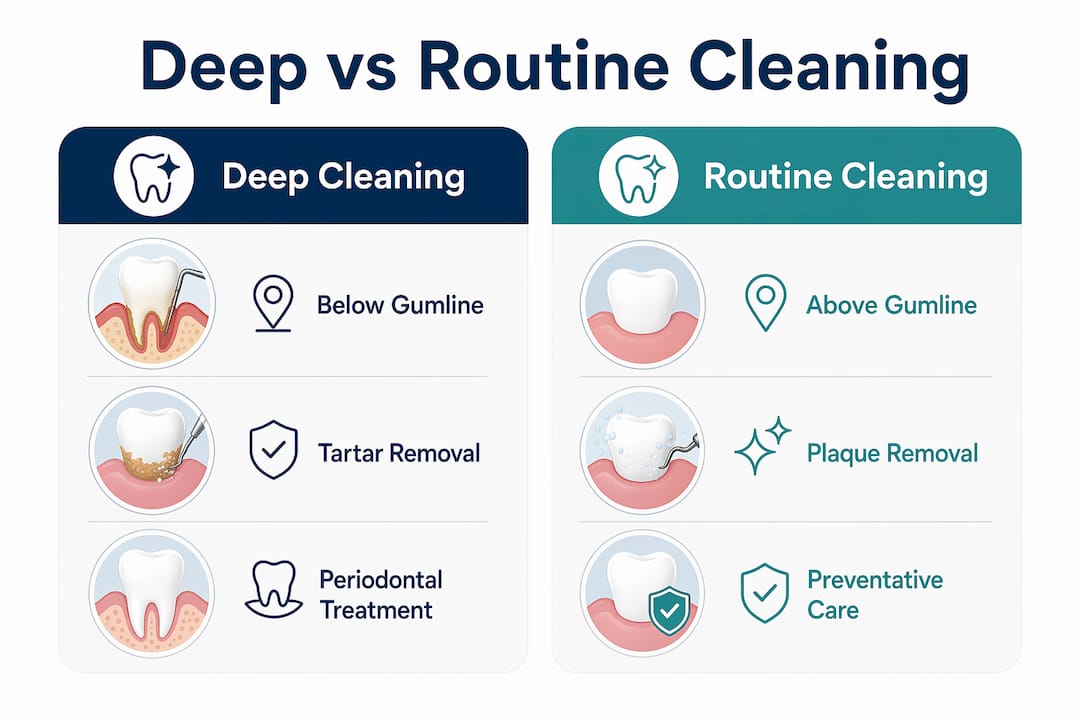
Routine cleaning and deep cleaning serve completely different clinical purposes. Routine cleaning, known as prophylaxis, is preventive. It removes plaque and tartar from surfaces above the gumline and is recommended for patients with healthy gums. Deep cleaning, by contrast, is a therapeutic procedure for patients with active gum disease.
The clinical term for deep cleaning is scaling and root planing. Scaling removes hardened tartar deposits from below the gumline. Root planing smooths the root surfaces so bacteria cannot reattach easily. Because the procedure reaches beneath the gums, local anaesthesia is required to keep you comfortable throughout.
The key differences at a glance:
- Routine cleaning: preventive, above the gumline, no anaesthesia needed, completed in a single visit
- Deep cleaning (scaling and root planing): therapeutic, below the gumline, local anaesthesia required, typically split across multiple appointments by quadrant
- Routine cleaning duration: standard appointments run around 60 minutes; new-patient visits with X-rays can take 90 minutes
- Deep cleaning duration: longer per session due to the depth of treatment and quadrant-based approach
Pro Tip: If your dentist recommends a deep clean and you are unsure why, ask them to show you your periodontal chart. The pocket depth measurements explain exactly why routine cleaning is no longer sufficient.
What are the signs that you need a deep cleaning?
The clearest clinical indicator is periodontal pocket depth greater than 4 millimetres on examination. Healthy gum pockets measure 1–3 mm. Once pockets deepen beyond 4 mm, bacteria accumulate below the gumline where a standard clean cannot reach. That bacterial load drives bone loss and worsening gum disease.
Beyond pocket depth, several symptoms point toward the need for professional oral deep cleaning:
- Bleeding gums when brushing or flossing, even gently
- Swollen or red gums that feel tender to touch
- Persistent bad breath that does not resolve with brushing
- Visible tartar buildup along the gumline, particularly on lower front teeth
- Gum recession where teeth appear longer than before
- Loose teeth or a change in how your bite feels
Dental X-rays play a critical role in diagnosis. They reveal bone loss around tooth roots that is invisible to the naked eye. A thorough periodontal exam combining X-rays with pocket depth charting gives your dentist the full picture before recommending gum treatment.
Early intervention matters. Gum disease that is caught at the gingivitis stage can often be reversed with a deep clean and improved home care. Left untreated, it progresses to periodontitis, which causes permanent bone loss and, eventually, tooth loss. The Australian Dental Association recommends regular dental check-ups specifically to catch these changes before they become irreversible.
What can you expect during a deep cleaning appointment?
A deep cleaning appointment follows a clear sequence. Knowing what happens at each step reduces anxiety and helps you prepare.
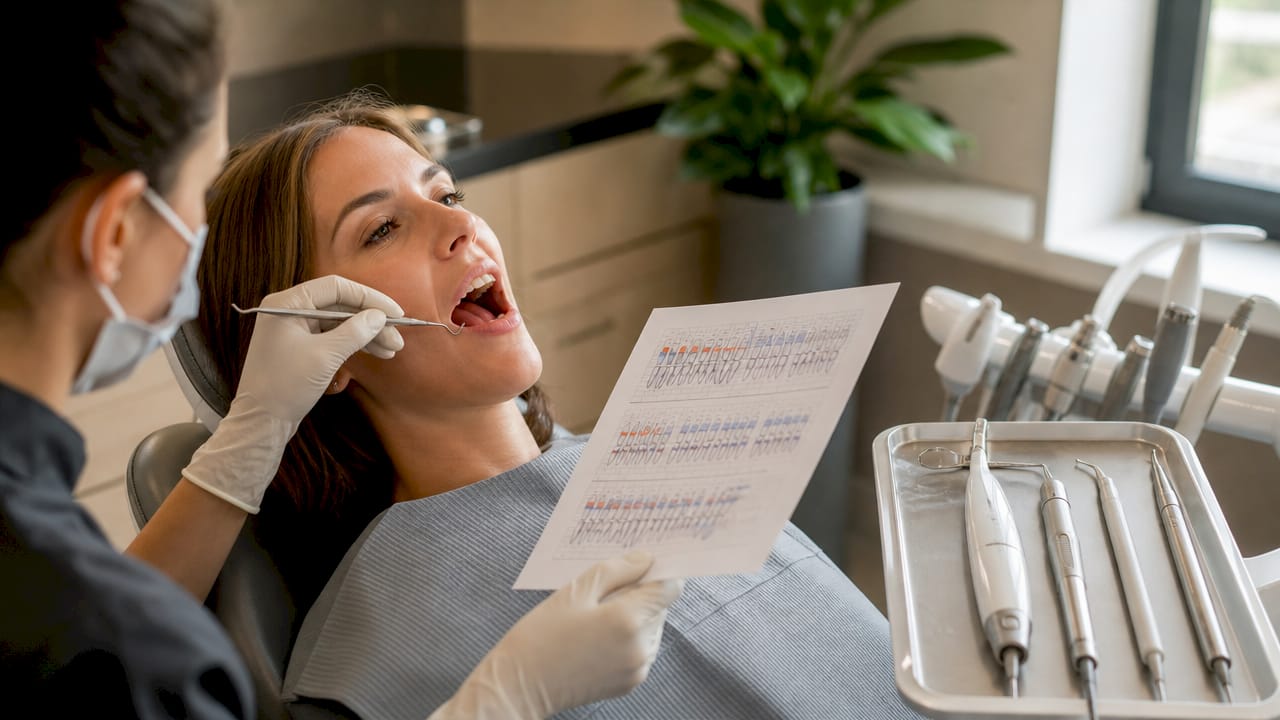
- Periodontal assessment: Your dentist or hygienist measures pocket depths and reviews X-rays to map the areas requiring treatment.
- Local anaesthesia: Numbing gel is applied first, followed by a local anaesthetic injection. You will feel pressure but not pain during the procedure.
- Scaling: Specialised instruments remove tartar and bacterial deposits from below the gumline, working down to the base of each pocket.
- Root planing: Root surfaces are smoothed to discourage bacteria from reattaching and to help gum tissue reattach to the tooth.
- Irrigation: The treated area is flushed with an antibacterial rinse to reduce residual bacteria.
- Post-treatment review: Your dentist explains home care instructions and schedules a follow-up to assess healing.
Because full mouth treatment is divided into quadrants, most patients attend two to four appointments. Treating one or two quadrants per visit keeps each session manageable and allows proper numbing without overloading you. Mild soreness and sensitivity for a few days after each session is normal. Over-the-counter pain relief and a soft diet help during recovery.
Pro Tip: Arrange a lift home after your first deep cleaning session. The anaesthesia affects your mouth for several hours, and eating or driving can be uncomfortable until the numbness fully wears off.
How much does deep cleaning cost in Western Sydney?
Deep dental cleaning cost is calculated per quadrant, not per tooth. The mouth is divided into four quadrants: upper left, upper right, lower left, and lower right. Per-quadrant pricing typically falls between $150 and $450 without insurance, making a full mouth treatment $600 to $1,800 depending on severity and the clinic’s location.
Routine professional teeth cleaning, by comparison, generally costs $90–$250 per visit and is often covered in full by private health insurance extras. Deep cleaning attracts a higher item number under Australian dental schedules, so your out-of-pocket cost depends on your level of cover.
Several factors influence the final price:
- Severity of gum disease: More advanced disease means more time and more quadrants requiring treatment
- Number of quadrants: Localised disease may require only one or two quadrants
- Clinic setting: Private practices in metropolitan areas typically charge more than suburban clinics
- Diagnostic requirements: X-rays and periodontal charting add to the initial appointment cost
For patients without private health cover, dental schools offer deep cleaning at 50–70% less than private practice rates. Treatment quality is comparable to private offices, though appointments run longer due to supervision requirements.
Paynless Dental offers affordable teeth cleanings across its Toongabbie and North Ryde clinics, with transparent pricing and flexible payment options. For a detailed breakdown of local costs, the deep cleaning cost comparison guide covers Western Sydney pricing in full.
Pro Tip: Call your health fund before your appointment and ask specifically about item numbers 114 and 222 (periodontal scaling). Knowing your rebate in advance removes the billing surprise.
How to maintain gum health after a deep cleaning
Deep cleaning is not a cure. Gum health after treatment depends entirely on consistent home care and regular professional maintenance. The procedure removes existing infection, but bacteria begin recolonising within hours. Your daily routine determines whether the results last.
The non-negotiable habits after scaling and root planing:
- Brush twice daily using a soft-bristled brush and fluoride toothpaste, angling the bristles toward the gumline
- Floss every day to disrupt bacterial colonies between teeth where brushes cannot reach
- Use an antibacterial mouthwash as directed by your dentist to reduce bacterial load
- Attend maintenance appointments every 3–4 months if your dentist recommends periodontal maintenance, rather than the standard twice-yearly schedule
Lifestyle factors also affect gum health significantly. Smoking is the single biggest risk factor for treatment failure after deep cleaning. It restricts blood flow to gum tissue and impairs healing. Managing blood sugar levels matters too, as gum disease and diabetes have a well-documented two-way relationship.
Your dentist will reassess pocket depths at your follow-up appointment, usually six to eight weeks after treatment. If pockets have reduced and gum tissue has reattached, the treatment has succeeded. If pockets remain deep, further intervention may be needed. Open communication with your dental team at every visit keeps your gum health on track.
Pro Tip: Set a phone reminder for your 3-month maintenance appointment before you leave the clinic. Patients who schedule immediately are far more likely to attend than those who plan to “call later”.
Key takeaways
Deep cleaning, or scaling and root planing, is the definitive treatment for active gum disease and requires a different approach, cost structure, and follow-up routine compared to routine professional teeth cleaning.
| Point | Details |
|---|---|
| Deep cleaning treats gum disease | Scaling and root planing removes bacteria below the gumline; routine cleaning does not reach there. |
| Pocket depth triggers the need | Periodontal pockets deeper than 4 mm indicate deep cleaning is required, confirmed by X-ray and charting. |
| Cost is per quadrant | Full mouth treatment ranges from $600 to $1,800 without insurance; dental schools offer 50–70% savings. |
| Multiple sessions are standard | Treatment is split by quadrant across two to four appointments for comfort and thoroughness. |
| Home care determines long-term success | Daily brushing, flossing, and 3–4 monthly maintenance visits protect the results of deep cleaning. |
What I have learned from seeing gum disease caught too late
Ashish here. After years working in dental care across Western Sydney, the pattern I see most often is this: patients arrive knowing something is wrong but having waited far longer than they should have. Bleeding gums get dismissed as “normal.” Bad breath gets blamed on diet. By the time they sit in the chair, what could have been a straightforward deep clean has become a much more involved conversation about bone loss.
The misconception I hear constantly is that deep cleaning is somehow extreme or aggressive. Patients hear “below the gumline” and assume the worst. The reality is that scaling and root planing is a well-established, routine procedure. The anaesthesia means you feel pressure, not pain. Most patients are genuinely surprised by how manageable it is.
What I want Western Sydney residents to understand is this: the procedure itself is the easy part. The hard part is the daily commitment afterward. I have seen patients invest in a full mouth deep clean and then skip flossing for six months. The infection returns. The procedure has to be repeated. The money and time spent the first time are wasted. Deep cleaning works when you treat it as the start of a new routine, not a one-off fix.
If cost is holding you back from getting a dental hygiene assessment, that concern is valid and worth discussing directly with a clinic. Affordable options exist in this region. The worst outcome is doing nothing.
— Ashish
Paynless Dental: professional deep cleaning in Western Sydney
Paynless Dental provides professional teeth cleaning services across two convenient Western Sydney locations: Toongabbie (serving Wentworthville, Pendle Hill, Seven Hills, and Westmead) and North Ryde (serving Macquarie Park, Ryde, Chatswood, and Eastwood). Both clinics offer thorough periodontal assessments, scaling and root planing, and transparent pricing with flexible payment options to keep quality care accessible. The team at Paynless Dental also provides dental crown services and a full range of restorative treatments for patients whose gum disease has progressed to tooth damage. Book a consultation at Paynless Dental to get a personalised assessment and a clear treatment plan without surprises.
FAQ
What is scaling and root planing?
Scaling and root planing is the clinical term for deep cleaning. It removes tartar and bacteria from below the gumline and smooths root surfaces to prevent bacterial reattachment.
How long does a deep cleaning appointment take?
Each quadrant session typically runs longer than a routine clean, often 45–90 minutes, because of the anaesthesia and the depth of treatment required.
Is deep cleaning painful?
Local anaesthesia is used throughout the procedure, so you feel pressure but not pain. Mild soreness and sensitivity for a few days after each session is normal and manageable with over-the-counter pain relief.
How often do I need deep cleaning after the initial treatment?
Patients with a history of gum disease typically require professional maintenance every 3–4 months rather than the standard twice-yearly schedule, to prevent reinfection.
Where can I find affordable deep cleaning teeth near me in Western Sydney?
Paynless Dental’s Toongabbie and North Ryde clinics offer affordable teeth cleanings with transparent pricing. Dental schools are also a lower-cost option, though appointments take longer due to supervision requirements.