
TL;DR:
- Government dental programs in Australia, like the Child Dental Benefits Schedule and public services, help cover basic treatments for eligible individuals, while private payment plans offer flexible financing for non-covered procedures. Selecting the appropriate option depends on eligibility, treatment type, and repayment capacity, with strategic scheduling maximizing benefits. Prompt emergency care through public clinics or private plans is vital to prevent worsening conditions and higher costs later.
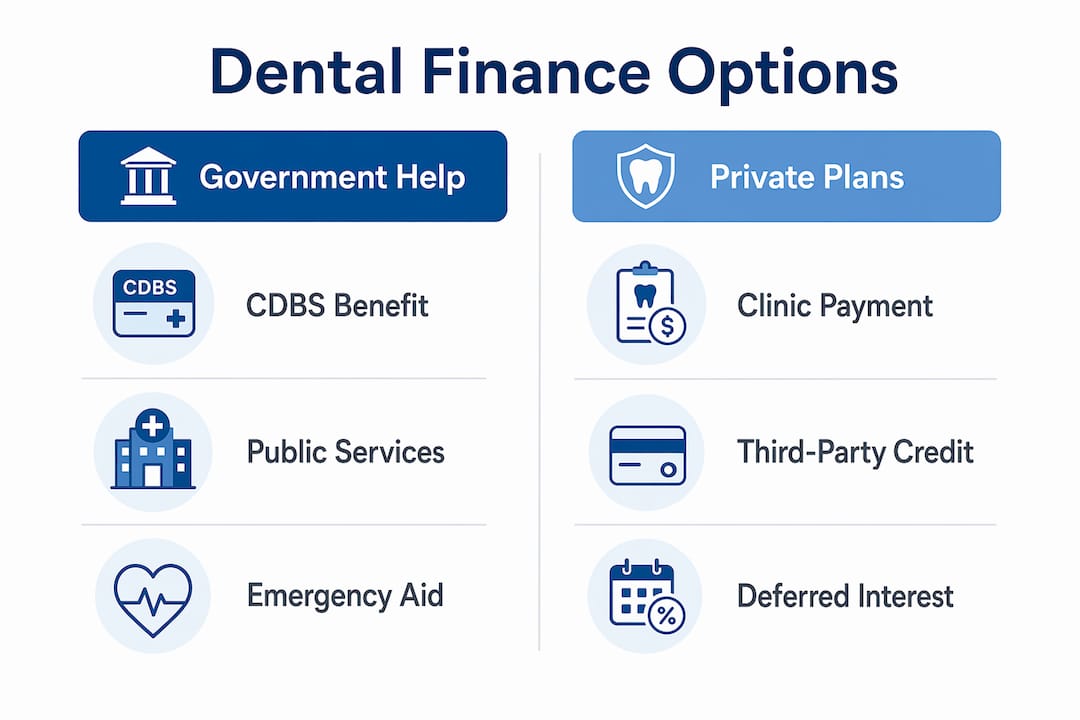
Dental finance help is the range of government programmes, private payment plans, and credit options that make dental care accessible when upfront costs are a barrier. For Australians, this includes federal schemes like the Child Dental Benefits Schedule (CDBS), state-based public dental services, and private financing through providers such as CareCredit or clinic-run payment plans. Understanding which option suits your situation, whether you need a routine check-up, dental implants, or emergency treatment, is the difference between getting care now and putting it off until the problem worsens.
What government dental finance help is available in Australia?
Government dental finance help in Australia divides into two main categories: eligibility-based public coverage and capped benefits for specific groups, such as children under the CDBS. The fastest access depends more on your eligibility category than on the procedure you need.

Child Dental Benefits Schedule (CDBS)
The CDBS is the most significant federal dental finance programme for families. It provides a capped benefit of $1,132 over two calendar years for basic dental services for children aged 0 to 17. That cap covers services like examinations, X-rays, cleaning, fillings, and extractions. It does not cover orthodontics, cosmetic procedures, or hospital-based treatment, so families need to plan accordingly.
Eligibility is linked to receiving a qualifying government payment such as Family Tax Benefit Part A. You can check eligibility and track remaining benefits through myGov. For a detailed breakdown of what the CDBS covers and how to use it effectively, the CDBS guide at Paynless Dental is a practical starting point.
Pro Tip: Schedule your child’s more expensive treatments, such as fillings or extractions, early in the two-year benefit period so you have remaining credit for follow-up care rather than exhausting the cap in year one.
Public dental services for adults in NSW
Adults in NSW can access free public dental services if they hold a valid Commonwealth concession card, including a Health Care Card, Pensioner Concession Card, or Commonwealth Seniors Health Card. This is not automatic for low-income individuals. You must present the physical card at every appointment. Dependents listed on a card may also qualify.
Public dental services cover basic treatments but typically have waiting lists. Specialist services such as implants or orthodontics are generally excluded. For a full picture of who qualifies in New South Wales, the affordable dental care guide for Western Sydney residents covers eligibility in detail.
| Programme | Who qualifies | Benefit or coverage |
|---|---|---|
| CDBS | Children 0–17 receiving Family Tax Benefit Part A | Up to $1,132 over 2 years for basic services |
| NSW public dental | Adults with valid Commonwealth concession card | Free basic dental treatment at public clinics |
| State emergency dental | Concession cardholders with acute dental pain | Emergency relief at public dental clinics |
What private dental payment plans can help spread costs?
Private dental finance plans are the most flexible option for treatments not covered by government programmes, including cosmetic work, implants, and major restorations. These plans fall into three broad types: clinic-run payment plans, third-party finance providers, and dental-specific credit products.
Clinic-run plans, such as those offered through DentiCare or Smile Right, allow patients to spread treatment costs over weekly or fortnightly instalments with no or low interest. These are arranged directly with the dental practice and often require no formal credit check for smaller amounts. The DentiCare payment plan options at Paynless Dental are structured to cover treatments from crowns and root canals through to full implant solutions.
Third-party providers like CareCredit offer no-interest promotional periods starting at $200 for qualifying purchases, ranging from 6 to 24 months, subject to credit approval. Longer-term reduced-APR options are available over up to 60 months with fixed monthly payments. This suits patients facing larger treatment costs who want predictable repayments.
Pro Tip: Before signing any finance agreement, ask the provider to confirm in writing whether the offer is deferred-interest or true zero-interest. The distinction matters significantly if you cannot clear the balance before the promotional period ends.
| Finance type | Best suited for | Key consideration |
|---|---|---|
| Clinic payment plan | Routine to mid-range treatments | Low or no interest, arranged in-practice |
| CareCredit or similar | Major treatments over $1,000 | Promotional periods require active management |
| Personal dental loan | Large or cosmetic procedures | Fixed repayments, credit check required |
| Interest-free credit card | Short-term cost spreading | Balance must clear within promotional window |
Combining public subsidies with private payment plans is a practical strategy. Families can use the CDBS for children’s basic dental care and direct private finance towards adult cosmetic or restorative work, covering the full household’s needs without a large single outlay.
How to assess eligibility and choose the right option
Choosing the right dental finance plan starts with three questions: Are you or your dependents eligible for a government programme? What type of treatment do you need? And what can you realistically repay each month?
Work through these steps before committing to any arrangement:
- Confirm your concession card status. Eligibility for public dental care is strictly tied to specific government-issued cards, not general low-income status. Check your card is current and that your dependents are listed correctly before booking.
- Match treatment type to the right programme. Basic care such as check-ups, fillings, and extractions can often be covered by the CDBS or public dental services. Cosmetic treatments, implants, and orthodontics require private financing.
- Map your CDBS balance before scheduling. The $1,132 cap is procedure-agnostic for basic services. Scheduling the most expensive covered treatments first maximises value from the benefit period.
- Compare total repayment cost, not just monthly instalments. A lower monthly payment over 60 months can cost significantly more than a higher payment over 24 months once interest is factored in.
- Ask your dentist for a written treatment plan with itemised costs. This lets you match each procedure to the most appropriate finance option rather than applying a single plan to the entire treatment.
Pro Tip: If you are considering dental implants and need help getting dental implants funded, ask your clinic whether they offer staged treatment. Spreading implant placement and restoration across two financial years can help you use two consecutive CDBS benefit periods for any covered components.
What financial help is available for dental emergencies?
Dental emergencies do not wait for convenient timing, and delaying treatment for cost reasons typically makes the problem more expensive to fix. Several pathways exist for urgent dental finance help in Australia.
Public dental clinics in NSW and other states provide emergency dental services for concession cardholders experiencing acute pain, swelling, or dental trauma. These services are free for eligible patients but are limited to pain relief, extractions, and stabilisation rather than full restorative work. Contact your local public dental service or the NSW Health dental helpline to locate the nearest clinic.
For patients without concession card eligibility, private clinics with in-house payment plans are the fastest route to care. Many practices, including Paynless Dental, can arrange same-day finance approval for emergency procedures such as root canals, extractions, or temporary crowns. The key points to confirm before proceeding are:
- Whether the finance plan covers the full treatment cost or only part of it
- The repayment start date, as some plans begin immediately while others defer the first payment
- Any fees for early repayment if your financial situation improves
- Whether the plan covers follow-up appointments or only the initial procedure
Delaying an emergency root canal or extraction to save money rarely works out. Infection can spread, bone loss can accelerate, and what was a single-tooth problem can become a full-mouth reconstruction. Getting finance in place quickly protects both your health and your long-term costs.
What are the common pitfalls when using dental finance help?
The most expensive mistake patients make with dental finance is assuming they are covered without verifying the details. Several specific errors come up repeatedly.
Not checking concession card validity before the appointment. NSW public dental services require you to present a valid card at every visit. An expired card or one that does not list your dependents will result in a declined service or an unexpected bill.
Misunderstanding deferred-interest financing. CareCredit and similar products often operate as deferred-interest loans. If you do not pay the full balance before the promotional period ends, retroactive interest is applied to the original amount, not just the remaining balance. This can add hundreds of dollars to a treatment that appeared interest-free.
Ignoring the CDBS cap when scheduling multiple treatments. Families who book all their children’s dental work at once without tracking the $1,132 limit can exhaust the benefit in a single visit, leaving nothing for the remainder of the two-year period.
Assuming cosmetic procedures qualify for public funding. Teeth whitening, veneers, and orthodontic treatment are not covered by the CDBS or public dental services. Patients who expect these to be subsidised are often caught off-guard by the full private cost.
Pro Tip: Ask your dental clinic for a pre-treatment cost estimate that separates Medicare-claimable items from out-of-pocket costs. This single document prevents most billing surprises and helps you plan your teeth payment plan with accurate figures.
Key takeaways
Effective dental finance help in Australia requires matching your eligibility category to the right programme, planning treatment schedules around benefit caps, and understanding the true cost of private financing before you sign.
| Point | Details |
|---|---|
| CDBS cap management | The $1,132 two-year cap for children rewards strategic scheduling of higher-cost treatments first. |
| Concession card verification | Public dental access requires a valid, current concession card presented at every visit. |
| Deferred-interest risk | Promotional finance periods must be actively managed to avoid retroactive interest charges. |
| Combine public and private | Use government schemes for basic care and private plans for cosmetic or major restorative work. |
| Emergency finance | Same-day payment plans at private clinics are the fastest route for urgent care without concession eligibility. |
Why I think most people approach dental finance backwards
Most patients I speak with start by asking “what can I afford?” and then look for a treatment that fits the budget. That approach almost always leads to under-treatment, delayed care, and higher costs down the track. The smarter sequence is to get a full treatment plan first, understand the total cost, and then work backwards through the available finance options.
The CDBS is genuinely underused by families who do not realise the benefit resets across two calendar years and can be strategically maximised. I have seen parents exhaust the full cap on a single visit when a bit of scheduling would have stretched it across two years of care. That is not a criticism of the programme. It is a planning gap.
For adults considering implants or major restorations, the combination of a clinic payment plan for the bulk of the cost and a government rebate for any covered components is almost always more affordable than a personal loan. The flexible payment options for dental implants at Paynless Dental are structured precisely for this scenario.
The one thing I would tell anyone delaying treatment for cost reasons: the longer you wait, the more complex and expensive the solution becomes. A single implant today costs less than a full-mouth reconstruction in five years. Get the finance sorted and get the treatment done.
— Ashish
How Paynless Dental makes financing dental care straightforward
Paynless Dental operates across two Sydney locations, Toongabbie and North Ryde, with transparent pricing and flexible dental pay plans designed for real budgets. Whether you need affordable dental implants, a root canal, crowns, or dentures, the team can structure a payment arrangement that spreads costs without surprises. Paynless Dental also offers root canal treatment with finance options and dental crown services at competitive prices. Book a consultation at either clinic to receive a written treatment plan with itemised costs and a finance option matched to your circumstances.
FAQ
What is the CDBS benefit cap for children in 2026?
The Child Dental Benefits Schedule provides up to $1,132 over two calendar years for basic dental services for eligible children aged 0 to 17. The cap covers examinations, X-rays, cleaning, fillings, and extractions but excludes orthodontics and cosmetic procedures.
Can adults get free dental care in NSW without private insurance?
Yes. Adults holding a valid Health Care Card, Pensioner Concession Card, or Commonwealth Seniors Health Card can access free public dental services in NSW. The card must be presented at every appointment, and coverage is limited to basic treatments.
What is the difference between a dental payment plan and a dental loan?
A dental payment plan is arranged directly with the clinic and typically involves no formal credit check for smaller amounts, with repayments spread over weeks or months. A dental loan is a credit product from a financial institution with a formal approval process, interest charges, and fixed repayment terms.
Does dental finance help cover implants?
Government programmes like the CDBS do not cover implants. Private dental finance plans, including clinic payment plans and products like CareCredit, can be used to fund implant treatment. Many clinics offer staged payment options specifically for implant procedures to make costs manageable.
What should I do if I need urgent dental care but cannot afford it?
Contact your nearest public dental clinic if you hold a valid concession card, as emergency dental services are available for acute pain and infection. If you do not hold a concession card, ask a private clinic about same-day payment plan approval, which many practices can arrange for emergency procedures such as extractions or root canals.