
TL;DR:
- Dental infection antibiotics in Australia are Schedule 4 prescription-only medicines that require a valid prescription from a registered healthcare professional. Telehealth and teledentistry now enable safe online prescriptions after a real-time assessment, but in-person treatment is always necessary to fully resolve the infection. Buying antibiotics from unregulated sources poses serious health risks, including the purchase of counterfeit or substandard medicines.
Dental infection antibiotics are Schedule 4 prescription-only medicines in Australia, meaning you cannot legally buy them over the counter or online without a valid prescription from a registered healthcare professional. That rule applies whether you visit a clinic in person or seek dental infection antibiotics online through a telehealth service. The Therapeutic Goods Administration (TGA) classifies antibiotics in this category to protect patients from misuse, resistance, and serious harm. The Australian Health Practitioner Regulation Agency (AHPRA) oversees the practitioners who can legally issue those prescriptions. The good news: telehealth and teledentistry now make it possible to get a legitimate prescription without leaving home, provided you consult a registered dentist or GP.
What legal regulations govern buying dental infection antibiotics online in Australia?
Antibiotics are Schedule 4 prescription-only medicines in Australia. That classification means no pharmacy, online or physical, can legally dispense them without a valid script from a registered prescriber.
The TGA sets the scheduling framework for all medicines sold in Australia. AHPRA registers the dentists, doctors, and other practitioners who are authorised to write those prescriptions. Both bodies work together to keep antibiotic supply tightly controlled.
Buying antibiotics online without a prescription is illegal under Australian law. Patients who attempt to source them from overseas websites or unregistered sellers face serious health and legal risks.
Key legal facts every patient should know:
- Schedule 4 status means antibiotics require a prescription at every point of sale, including online pharmacies.
- Valid Australian prescription must come from an AHPRA-registered practitioner who has assessed you clinically.
- Telehealth prescriptions are legal when issued after a real-time consultation with a registered doctor or dentist.
- Online pharmacies operating legally in Australia must hold a pharmacy licence and require a valid script before dispensing.
- Overseas sellers are not bound by Australian law and frequently supply counterfeit, substandard, or incorrectly dosed medicines.
Pro Tip: Check that any online pharmacy you use displays its Australian pharmacy licence number and requires you to submit a prescription before checkout. If neither is visible, leave the site immediately.
The risk of purchasing from unregulated sources goes beyond legality. Unsafe online antibiotic purchases risk counterfeit, substandard, or unregulated medicines that may be ineffective or harmful. A course of antibiotics that contains the wrong dose or an inactive ingredient will not clear your infection. It may also mask symptoms long enough for a serious abscess to spread.
How do telehealth and teledentistry enable safe online prescriptions?
Telehealth consultations enable registered Australian doctors and dentists to assess and prescribe antibiotics legally during real-time video or phone consultations. This is the only legitimate pathway to get antibiotics for a tooth infection online in Australia.
The process follows a clear clinical structure. A registered practitioner will not simply take your word for it and issue a script. They conduct a proper assessment before prescribing anything.
Here is what a standard teledentistry consultation involves:
- Book a consultation through a registered telehealth or teledentistry platform that employs AHPRA-registered practitioners.
- Describe your symptoms in detail, including when the pain started, whether there is swelling, and your temperature.
- Share photos or video of the affected area so the practitioner can visually assess the infection site.
- Provide your medical history, including any allergies, current medications, and previous antibiotic use.
- Red-flag screening is conducted to rule out severe systemic infection requiring emergency care.
- Receive your eScript electronically if the practitioner determines antibiotics are clinically appropriate.
- Submit the eScript to a licensed Australian pharmacy for dispensing or home delivery.
Electronic prescriptions (eScripts) simplify obtaining antibiotics online by securely transmitting prescriptions to Australian pharmacies. The eScript system removes the need to physically handle a paper script while maintaining full legal compliance.
Pro Tip: Before your telehealth appointment, photograph the affected area in good lighting and write down your symptoms, their severity, and when they started. This shortens the consultation and helps the practitioner make a more accurate assessment.
One critical limitation applies to all online consultations. Dentists can prescribe antibiotics online after a virtual assessment, but the underlying dental problem, such as an abscess, cracked tooth, or infected root, still requires in-person treatment. Antibiotics manage the infection temporarily. They do not fix the structural cause.
What antibiotics are commonly prescribed for dental infections?
Amoxicillin 500mg three times daily for 7 days is the most common first-line antibiotic prescribed for dental infections. It targets the bacterial strains most often responsible for tooth abscesses and periapical infections.

Understanding the options helps you have a more informed conversation with your prescriber. The table below outlines the antibiotics most frequently used for dental infections in Australia.
| Antibiotic | Typical use | Notes |
|---|---|---|
| Amoxicillin | First-line for most dental infections | Penicillin-based; not suitable for penicillin allergy |
| Amoxicillin with clavulanic acid | Broader coverage for resistant infections | Stronger option when standard amoxicillin is insufficient |
| Metronidazole | Used adjunctively with amoxicillin | Targets anaerobic bacteria common in dental abscesses |
| Clindamycin | Alternative for penicillin-allergic patients | Effective but carries a higher risk of gut side effects |
| Erythromycin | Second-line alternative for penicillin allergy | Less commonly used due to resistance patterns |
Completing the full prescribed course is non-negotiable. Antibiotic resistance increases when antibiotics are used improperly or without appropriate clinical oversight. Stopping early because you feel better is one of the most common ways resistance develops.
Patients should also be aware of the following before starting any antibiotic course:
- Allergy history must be disclosed to your prescriber before any antibiotic is issued.
- Drug interactions are possible with blood thinners, oral contraceptives, and some antifungals.
- Side effects including nausea, diarrhoea, and thrush are common and should be reported if severe.
- Antibiotics alone do not cure dental infections. They reduce bacterial load and manage symptoms until definitive dental treatment is completed.
You can read more about how dentists assess antibiotic need and what the clinical decision process looks like before a prescription is issued.
What are the dangers of buying dental antibiotics from unregulated sources?
Websites selling antibiotics without prescriptions are illegal in Australia and often distribute counterfeit or poor-quality medications. The financial saving is not worth the clinical risk.
Unregulated online sellers operate outside Australian law. They have no obligation to verify your identity, check your medical history, or supply medicines that meet TGA quality standards. The product you receive may contain the wrong active ingredient, an incorrect dose, or no active ingredient at all.
“Online services that do not require a consultation or prescription before dispensing antibiotics are unsafe and should be avoided. Pharmacists and health practitioners consistently warn that these platforms put patients at serious risk of harm, including treatment failure, allergic reactions, and antibiotic resistance.”
Signs that an online provider is legitimate:
- Requires a valid Australian prescription before dispensing any medicine.
- Employs a registered pharmacist who reviews scripts before fulfilment.
- Uses a secure, encrypted portal for script submission and patient data.
- Displays an Australian pharmacy licence number on its website.
- Does not offer to “consult” you via a simple online questionnaire with no real-time assessment.
Signs that a provider is not legitimate:
- Offers antibiotics without any prescription requirement.
- Prices are unusually low compared to standard Australian pharmacy rates.
- No Australian business address or licence number is visible.
- Payment is requested via cryptocurrency or untraceable transfer methods.
Pro Tip: The Healthdirect website maintains a directory of registered telehealth services in Australia. Use it to verify any online provider before sharing your personal or medical information.
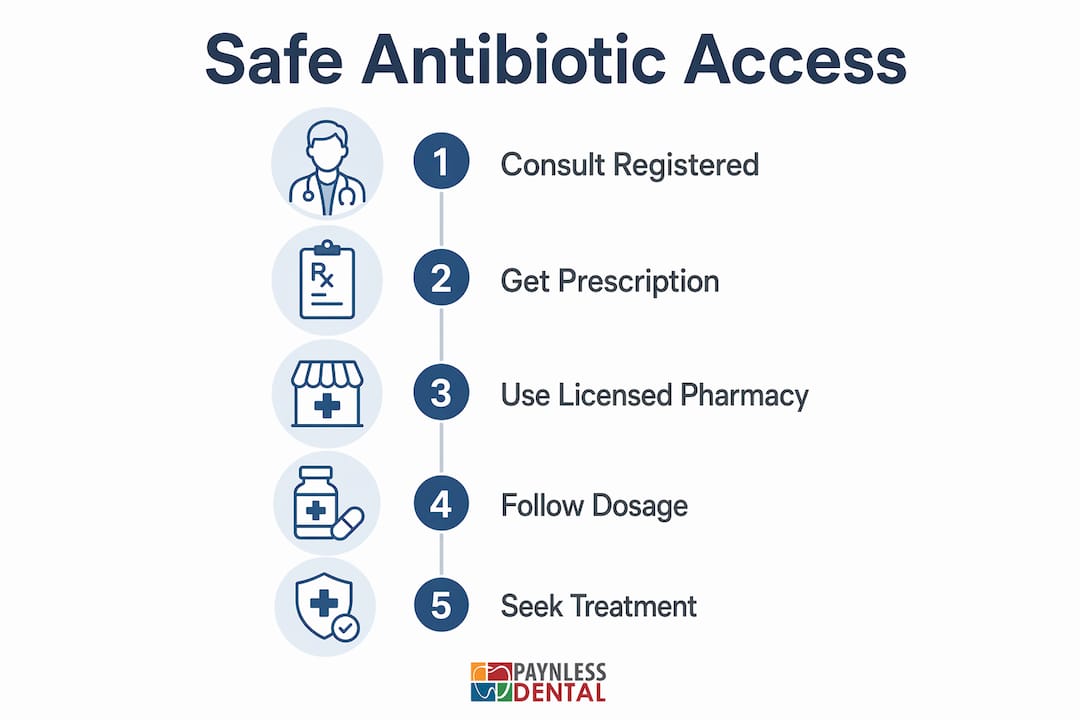
How to safely obtain dental infection antibiotics online: practical steps
Getting antibiotics for a tooth infection online legally in Australia follows a clear process. Knowing the steps in advance reduces delays and helps you get treatment faster.
- Identify your symptoms early. Swelling, throbbing pain, sensitivity to heat, and a bad taste in your mouth are common signs of a dental infection that warrant prompt assessment.
- Book a telehealth or teledentistry consultation with a platform that employs AHPRA-registered practitioners. Confirm registration before booking.
- Prepare for your consultation. Have your Medicare card, a list of current medications, known allergies, and clear photos of the affected area ready.
- Attend the real-time consultation. Answer all questions honestly. The practitioner needs accurate information to prescribe safely.
- Receive your eScript. If antibiotics are appropriate, your practitioner will send the eScript directly to your nominated pharmacy or to you via SMS or email.
- Collect or arrange delivery from a licensed Australian pharmacy. Many pharmacies now offer same-day or next-day delivery.
- Book an in-person dental appointment. Antibiotics manage the infection. The underlying cause, whether an abscess, decay, or damaged pulp, requires clinical treatment such as root canal therapy or extraction.
- Seek emergency care immediately if you develop facial swelling spreading toward your eye or neck, difficulty breathing or swallowing, or a fever above 38.3°C. These symptoms indicate a potentially life-threatening systemic infection that telehealth cannot manage.
The steps above reflect the standard of care expected under Australian telehealth guidelines. Following them protects you legally and clinically.
Key takeaways
Dental infection antibiotics in Australia are prescription-only medicines that can be legally obtained online only through a registered practitioner conducting a real-time telehealth or teledentistry assessment.
| Point | Details |
|---|---|
| Prescription is mandatory | Antibiotics are Schedule 4 medicines; no legal online or in-person sale occurs without a valid script. |
| Telehealth is a legal pathway | Registered Australian doctors and dentists can prescribe antibiotics online after a real-time clinical assessment. |
| Amoxicillin is first-line | Amoxicillin 500mg three times daily for 7 days is the standard first prescription for most dental infections. |
| Unregulated sellers are dangerous | Websites selling antibiotics without prescriptions are illegal and frequently supply counterfeit or substandard medicines. |
| Antibiotics treat symptoms, not causes | In-person dental treatment is always required to resolve the underlying infection source. |
Teledentistry is genuinely useful, but it is not a shortcut
I have seen a sharp rise in patients arriving at Paynless Dental after a telehealth consultation, antibiotics in hand, expecting the infection to be resolved. The antibiotics have done their job. The swelling is down. The pain is manageable. But the abscess, the cracked root, the decayed pulp, it is all still there. Telehealth is a legitimate and genuinely valuable tool for getting timely antibiotic cover. I have no argument with that. What concerns me is the growing assumption that an online prescription is the end of the treatment, not the beginning.
The other pattern I see regularly is patients who have tried to source antibiotics without a prescription, either from overseas websites or by using a leftover course from a previous infection. Both approaches are dangerous. The wrong antibiotic, the wrong dose, or an incomplete course does not just fail to clear the infection. It creates resistant bacteria that are significantly harder to treat the second time around.
My honest advice: use telehealth for what it does well. It gets you assessed quickly, it gets antibiotics to you legally and safely, and it buys time until you can be seen in person. But treat the online prescription as step one, not the whole plan. The tooth still needs attention.
— Ashish
Paynless Dental: professional care from assessment to treatment
A prescription manages a dental infection short-term. Resolving it properly requires clinical treatment from a registered dentist. Paynless Dental provides thorough assessments, accurate diagnoses, and the full range of treatments needed after antibiotic therapy, including root canal treatment for infected pulp, extractions, and restorations. The team at both the Toongabbie and North Ryde clinics is experienced in managing dental infections at every stage, from initial assessment through to definitive care. If you are currently dealing with a tooth infection, do not wait for it to worsen. Book an appointment at Paynless Dental and get the right treatment from registered clinicians who take your comfort and safety seriously.
FAQ
Can you buy dental infection antibiotics online in Australia?
You cannot legally buy dental infection antibiotics online in Australia without a valid prescription from a registered doctor or dentist. Telehealth services allow you to get that prescription online after a real-time clinical assessment.
What is the most common antibiotic prescribed for a tooth infection?
Amoxicillin 500mg three times daily for 7 days is the standard first-line antibiotic for most dental infections in Australia. Patients with a penicillin allergy are typically prescribed clindamycin or erythromycin instead.
Is it safe to get amoxicillin for a tooth infection online?
Getting amoxicillin for a tooth infection online is safe when the prescription comes from an AHPRA-registered practitioner following a real-time telehealth consultation. Learn more about obtaining amoxicillin safely through the correct legal process.
When should I go to emergency care instead of using telehealth?
Seek emergency care immediately if you have facial swelling spreading toward your eye or neck, difficulty breathing or swallowing, or a fever above 38.3°C. These symptoms indicate a systemic infection that requires urgent in-person treatment, not a telehealth prescription.
Do antibiotics cure a tooth infection permanently?
Antibiotics reduce bacterial load and manage symptoms but do not cure the underlying dental problem. Definitive treatment such as root canal therapy, drainage, or extraction is always required to permanently resolve a dental infection.