
Dental implants are changing the way Aussies fix missing teeth. These clever little screws can help preserve up to 80 percent of your original jawbone density, unlike dentures that let bone melt away over time.
You’d think it would be all about a better smile or easier chewing. The real win is how dental implants actually stop your face from sinking and keep you looking fresher for years.
Table of Contents
- What Are Dental Implants And How Do They Work?
- Why Dental Implants Matter For Your Oral Health
- The Structure Of Dental Implants: Key Components Explained
- Understanding The Benefits Of Choosing Dental Implants
- Real-World Applications: Who Can Benefit From Implants?
Quick Summary
| Takeaway | Explanation |
|---|---|
| Dental implants mimic natural teeth | They serve as artificial roots, promoting oral function and preventing bone loss. |
| Three key components ensure stability | Implants consist of a titanium post, abutment, and custom crown, working together for durability. |
| Prevent bone loss and maintain structure | Implants stimulate jawbone health, preserving facial contours and preventing adjacent tooth misalignment. |
| Long-lasting and cost-effective solution | With proper care, implants can last decades, resulting in fewer dental issues and lower long-term costs. |
| Suitable for various patients | Ideal for individuals with missing teeth, advanced decay, or periodontal disease, enhancing oral rehabilitation opportunities. |
What Are Dental Implants and How Do They Work?
Dental implants represent a revolutionary approach to replacing missing teeth, offering patients a permanent and natural-looking solution that goes beyond traditional dental restoration methods. These sophisticated medical devices are essentially artificial tooth roots surgically placed into the jawbone, providing a robust foundation for replacement teeth that look, feel, and function like natural teeth.
The Fundamental Structure of Dental Implants
At their core, dental implants consist of three primary components that work harmoniously to recreate a complete tooth structure:
- Titanium Implant Post: A small, biocompatible screw surgically inserted directly into the jawbone, acting as an artificial tooth root
- Abutment: A connector piece that sits above the gum line, linking the implant post to the replacement tooth
- Prosthetic Crown: The visible tooth-like structure custom-designed to match surrounding natural teeth
According to the Mayo Clinic, these implants are meticulously engineered to integrate with human bone through a process called osseointegration. This biological bonding allows the titanium implant to become a stable, permanent part of a patient’s dental anatomy.
How Dental Implants Restore Functional Dentition
The implantation process involves a carefully planned surgical procedure where the titanium post is precisely positioned within the jawbone. Over several months, the bone naturally grows around the implant, creating an incredibly strong and stable foundation. This biological integration ensures that the implant can withstand the significant biting and chewing forces experienced during daily eating.
Unlike removable dentures or bridges, dental implants provide a fixed solution that prevents bone deterioration, maintains facial structure, and restores full chewing functionality. Explore our comprehensive guide on dental implant procedures to understand the intricate details of this transformative dental technology.
Why Dental Implants Matter for Your Oral Health
Dental implants transcend simple tooth replacement, offering a comprehensive solution that profoundly impacts overall oral health and quality of life. These advanced prosthetic devices do more than fill a cosmetic gap they actively contribute to maintaining the structural integrity of your entire mouth, preventing a cascade of potential dental complications.
Preventing Bone Loss and Maintaining Facial Structure
When a tooth is lost, the underlying jawbone begins to deteriorate due to lack of stimulation. Dental implants are uniquely designed to mimic natural tooth roots, providing continuous bone stimulation that prevents bone resorption. This critical function helps maintain facial bone density and prevents the sunken appearance often associated with missing teeth.
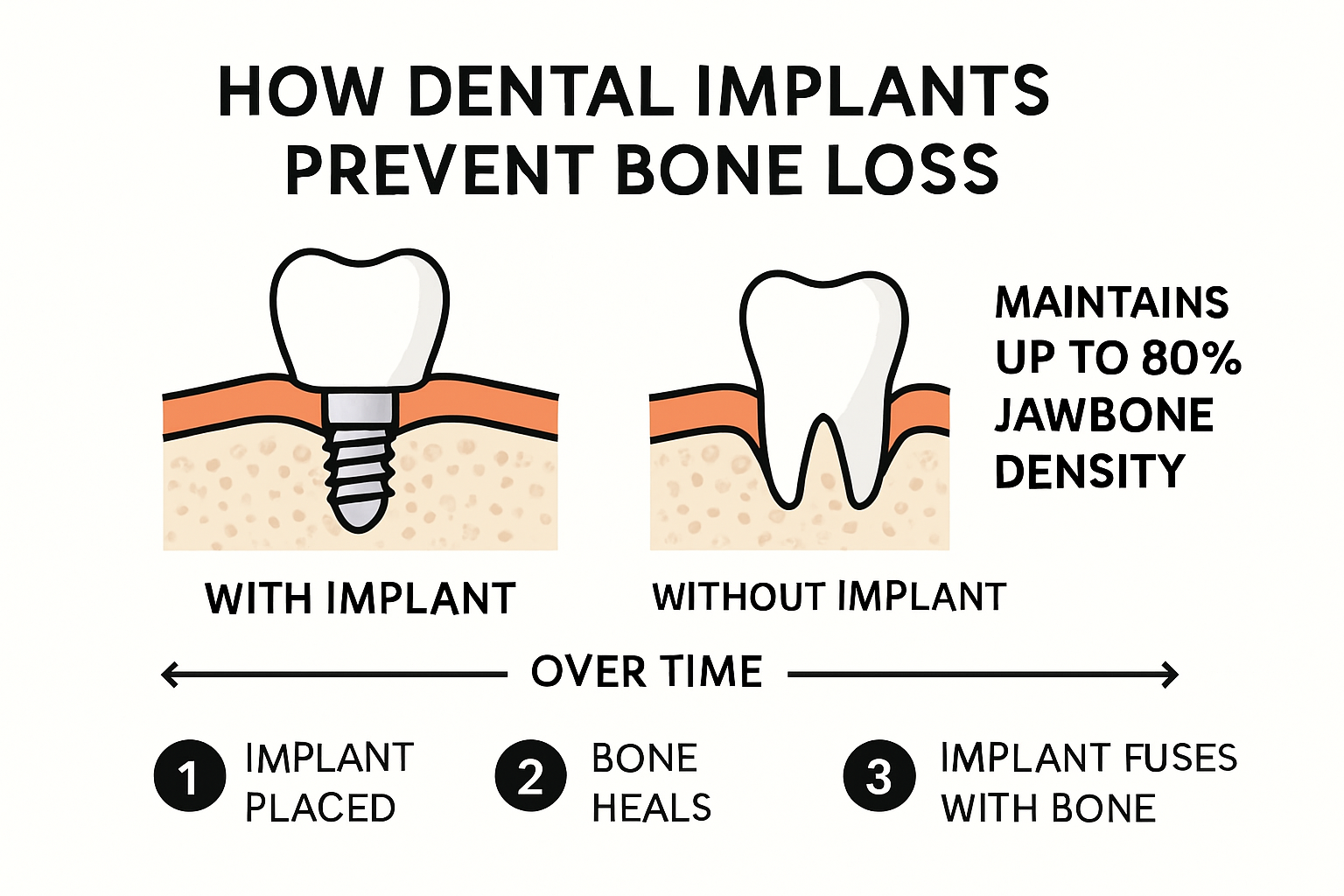
Key benefits of dental implants for bone health include:
- Stimulating bone tissue to prevent deterioration
- Maintaining natural facial contours and structure
- Preventing adjacent teeth from shifting out of alignment
- Supporting long-term oral health and jaw stability
According to the National Institutes of Health, dental implants represent a superior tooth replacement strategy that actively preserves bone structure and prevents the progressive bone loss common with traditional dental solutions.
Comprehensive Oral Function and Health Protection
Beyond aesthetic considerations, dental implants restore complete oral functionality. They enable proper chewing mechanics, support clear speech, and distribute bite forces evenly across the jaw. This balanced approach prevents additional wear on surrounding teeth and helps maintain overall dental alignment.
Moreover, implants create a seamless restoration that does not compromise adjacent healthy teeth, unlike traditional bridges that require grinding down neighboring teeth. Learn more about our advanced implant techniques and how they contribute to comprehensive oral health restoration.
The Structure of Dental Implants: Key Components Explained
Dental implants represent a sophisticated engineering marvel in modern dentistry, combining biocompatible materials and precise design to create a permanent tooth replacement solution. Unlike traditional dental prosthetics, these advanced devices are meticulously constructed to replicate the complex functionality of natural teeth, offering patients a seamless and durable restoration.
The Fundamental Architectural Design
A dental implant is composed of three critical interconnected components, each playing a vital role in creating a stable and functional tooth replacement:
- Titanium Implant Post: A surgical grade, biocompatible screw designed to integrate directly with the jawbone
- Connecting Abutment: A precision engineered connector that links the implant post to the prosthetic tooth
- Custom Prosthetic Crown: A precisely crafted artificial tooth matched to surrounding natural teeth
According to research published in the National Center for Biotechnology Information, this three part structure allows dental implants to provide unparalleled stability and functional performance compared to traditional tooth replacement methods.
Material Science and Biocompatibility
The selection of materials is crucial in dental implant design. Titanium stands out as the primary material for the implant post due to its exceptional properties. This metal possesses remarkable biocompatibility, enabling it to integrate seamlessly with human bone tissue through a process called osseointegration. This biological bonding creates an incredibly strong foundation that mimics natural tooth root structures.
Discover the intricacies of our advanced implant procedures to understand how these sophisticated components work together to restore both function and aesthetics in dental restoration.
Understanding the Benefits of Choosing Dental Implants
Dental implants represent far more than a cosmetic solution for missing teeth. They are a comprehensive approach to oral health restoration that offers multiple long-term advantages, transforming patients’ quality of life through advanced medical technology and precision engineering.
Functional and Aesthetic Restoration
Unlike traditional tooth replacement methods, dental implants provide a permanent and natural-looking solution that seamlessly integrates with existing dental structures. These sophisticated prosthetics restore not just the visible tooth, but the entire functional mechanism of a natural tooth root, enabling patients to eat, speak, and smile with complete confidence.
Key functional benefits include:
- Full restoration of chewing capacity
- Prevention of bone loss in the jaw
- Maintenance of facial muscle structure
- Elimination of speech impediments caused by missing teeth
- Improved overall oral health and alignment
According to the Mayo Clinic, dental implants offer significant improvements over traditional dental restoration techniques by providing stable support for artificial teeth without compromising adjacent healthy teeth.
To help clarify the specific advantages of dental implants compared to traditional dentures and bridges, the following table summarises the key differences discussed in the article:
| Feature | Dental Implants | Traditional Dentures/Bridges |
|---|---|---|
| Jawbone Preservation | Stimulates and preserves bone | Allows bone loss over time |
| Stability | Fixed, does not move | May slip or move during eating/speaking |
| Impact on Adjacent Teeth | No alteration needed | May require grinding of neighbouring teeth |
| Chewing Ability | Restores full function | Reduced chewing efficiency |
| Longevity | Can last decades with proper care | May require more frequent replacement |
| Facial Structure Maintenance | Maintains natural facial contours | Can lead to facial collapse (sunken look) |
Long-Term Health and Economic Advantages
Dental implants are not merely a short-term solution but a long-term investment in oral health. Their durability and biocompatibility mean they can last decades with proper care, often outlasting traditional bridges or dentures. The initial investment translates into reduced long-term dental maintenance costs and minimized potential future dental complications.

Learn more about our comprehensive implant evaluation process to understand how these remarkable medical devices can transform your dental health and overall quality of life.
Real-World Applications: Who Can Benefit from Implants?
Dental implants represent a versatile solution for individuals experiencing diverse dental challenges, offering hope and restoration beyond traditional tooth replacement methods. Their adaptability makes them a groundbreaking option for patients with varying oral health needs and complex dental histories.
Patient Profiles and Dental Restoration Scenarios
The range of candidates for dental implants is broader than many patients realise. Ideal candidates encompass multiple demographic groups and dental conditions, extending far beyond simple single tooth replacement:
- Adults with one or multiple missing teeth
- Patients with significant tooth decay or advanced periodontal disease
- Individuals with congenital tooth absence
- Patients seeking permanent alternatives to removable dentures
- Those experiencing bone loss or compromised jaw structure
According to research published in the Journal of the American Dental Association, dental implants are particularly indicated for partially or fully edentulous patients, providing comprehensive oral rehabilitation across different scenarios.
To provide a clear overview of who might benefit most from dental implants, the following table outlines common patient profiles and oral health scenarios cited in the article:
| Candidate Scenario | Suitability for Dental Implants | Key Benefits Provided |
|---|---|---|
| Adults with missing teeth | Highly suitable | Permanent solution, restores function |
| Advanced tooth decay | Suitable if bone/gum health permits | Long-term replacement, improves health |
| Periodontal (gum) disease | Suitable after managing gum disease | Prevents further loss, stabilises jaw |
| Congenital absence of teeth | Suitable | Comprehensive oral rehabilitation |
| Individuals with removable dentures | Excellent alternative | Fixed, comfortable, natural appearance |
| Patients with bone loss | Suitable with preparatory bone grafting | Preserves/rebuilds jawbone structure |
Medical Considerations and Suitability Factors
While dental implants offer remarkable solutions, not every patient is an immediate candidate. Successful implantation requires careful evaluation of several critical health parameters. Patients must demonstrate adequate bone density, healthy gum tissue, and overall systemic health that supports surgical intervention and healing processes.
Certain medical conditions might require additional preparatory treatments or alternative approaches. Patients with uncontrolled diabetes, active periodontal disease, or those undergoing specific medical treatments may need comprehensive assessment and potential preliminary interventions.
Explore our personalised implant consultation process to understand how we tailor dental implant solutions to individual patient needs and health profiles.
Discover Lasting Confidence with Dental Implants at Painless Dental
If you are tired of the daily frustrations that come with missing teeth or loose dentures, you are not alone. As explained in the article above, dental implants can stop bone loss, support your jaw, and bring back the freedom to eat, speak and smile without worry. Many patients find that the loss of natural teeth can impact their appearance and quality of life, leading to discomfort and self-consciousness. Our advanced solutions such as single tooth implants, full mouth reconstruction or implant-supported dentures address these concerns precisely and give you back what you are missing.
Take the first step toward restoring strength, comfort and a natural smile. Visit Painless Dental to explore premium implant options tailored for you using the latest in dental technology. Want to know how these treatments work and if you qualify? Learn more about our dental implant care and process. Your journey to a confident, healthy smile can start today. Book your personal consultation now and experience why so many in Toongabbie, North Ryde and surrounding areas trust us for their dental implant needs.
Frequently Asked Questions
What are dental implants?
Dental implants are artificial tooth roots made of titanium that are surgically placed into the jawbone to support replacement teeth, offering a permanent and natural-looking solution for missing teeth.
How do dental implants work?
Dental implants work by undergoing a process called osseointegration, where the bone grows around the titanium implant, creating a stable and strong foundation for prosthetic crowns that function like natural teeth.
What are the benefits of choosing dental implants over traditional dentures or bridges?
Dental implants provide several advantages, including the prevention of bone loss, maintenance of facial structure, full restoration of chewing ability, and a stable solution that does not require altering adjacent healthy teeth.
Who is a good candidate for dental implants?
Good candidates for dental implants include adults with missing teeth, those with significant tooth decay, individuals seeking permanent replacements for removable dentures, and those with sufficient bone density to support the implants.
Recommended
- A Comprehensive Guide to Dental Implants: Types, Procedure, and Aftercare – Paynless Dental Clinic
- A Comprehensive Guide to Dental Implants: Types, Procedure, and Aftercare – Paynless Dental Clinic
- The Ultimate Guide to Dental Veneers: Transform Your Smile with Veneers – Paynless Dental Clinic
- The Ultimate Guide to Dental Veneers: Transform Your Smile with Veneers-to be deleted – Paynless Dental Clinic